

1Introduction: Why Savannah Matters
By the late nineteenth century, celebrity had become a distinctly modern phenomenon, a fusion of publicity, persona, and performance that, as Daniel Boorstin observed, made a person “well known for being well known” (57). In that context, we can trace a throughline from Lord Byron, who “woke up famous” and was described as “mad, bad, and dangerous to know,” to Sarah Bernhardt, whose carefully orchestrated tours crowned her as the “first celebrity.” But right in between stood Oscar Wilde, who in 1882 crossed the Atlantic in his velvet and ruffles, long hair and lilies, to test how art, commerce, and identity could converge on a public stage. Wilde’s 260-day lecture tour across North America made him one of the first truly international celebrities, known, at that moment, more for his image than his art. At twenty-seven, the aspiring British writer achieved that status in no small part through his lecture tour of America, which covered thirty states and fifteen thousand miles. Yet while scholars have chronicled Wilde’s urban triumphs in New York, Boston, and San Francisco, his travels in the American South, particularly his July 1882 trip to Georgia, remain strikingly understudied. This essay argues that Wilde’s 1882 Savannah, Georgia, visit illuminates how modern celebrity was not only produced by the press but also intentionally self-choreographed, collaborated on with the public, and then negotiated through regional hierarchies of race, gender, and class in the post–Reconstruction South.
As David Friedman notes, Wilde “created the value system we now call celebrity culture,” yet in his Oscar Wilde in America, the Savannah visit receives less than a paragraph of consideration (16). A closer examination of the southern leg of Wilde’s tour—from June 12 to July 12, 1882, during which he delivered eighteen of the 141 lectures—reveals the cultural work that fame performed in a society negotiating reconstruction and modernity. The Savannah moment offers a critical microhistory of how celebrity was produced at that time and reveals the mechanics of modern fame at their most volatile: the collaboration and collision of media, public opinion, and persona that Sharon Marcus calls the “drama of celebrity.” Savannah’s layered history, as a post-Confederate port city negotiating its image of gentility and modernity, make it a revealing stage for Wilde’s experiment in self-display.
The essay proceeds in four parts: First, I examine Wilde’s self-manufactured celebrity; then, I explore how his southern tour, especially Savannah, tested those performances against regional norms and hierarchies of gender, gentility, and race; next, I trace the press and public response; and finally, I consider how Savannah’s reception refracted the South’s struggle to reconcile cosmopolitanism and civility. More than a curious footnote to his American lecture tour, Savannah exposes how a global celebrity adapted himself to and was ultimately shaped by the local politics of recognition in the postbellum South. The press coverage, correspondence, and iconography surrounding Wilde’s southern performances demonstrate how celebrity functioned as a form of cultural negotiation, linking art to commerce, fascination to hostility, individuality to stereotype.
2The Machinery of Fame: Press, Persona, and Performance
Oscar Wilde did not simply become famous: He engineered his fame. His 1882 American tour was not just a lecture circuit but a calculated performance of identity, designed to captivate audiences and dominate headlines. In Declaring His Genius: Oscar Wilde in North America, literary historian Roy Morris recounts that prior to his travels, Wilde also went to lectures on the colonies at the British Museum, read up on Dickens’s tours, took elocution lessons, and had his tailor design his wardrobe, all as part of the creation of the Wilde persona and performance. In other words, he prepared to play the part. If Savannah dramatizes the local negotiation of celebrity, the American tour as a whole reveals fame as a performance, a collaboration among media, public, and persona.
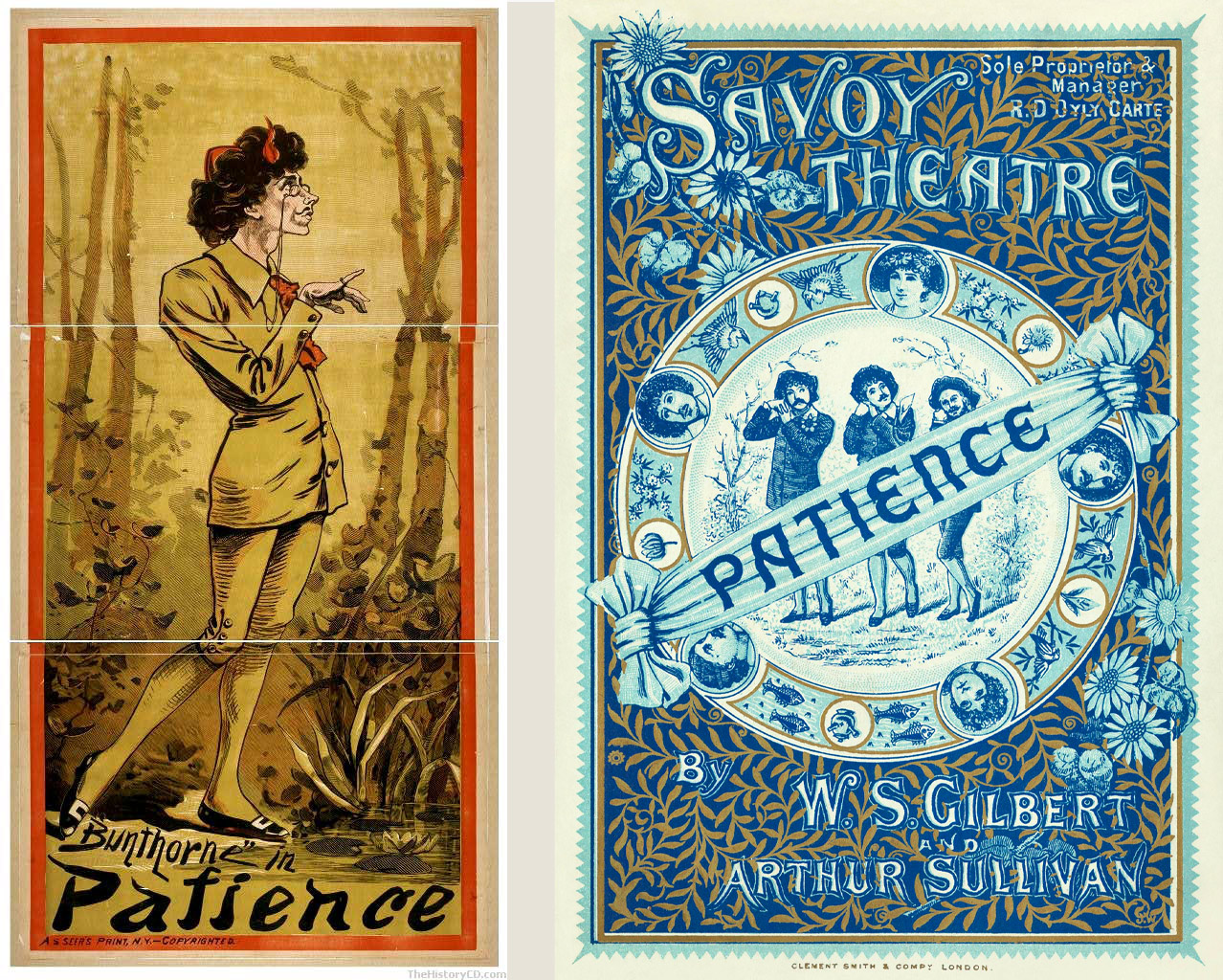
There is something extraordinary about Wilde’s celebrity at this moment in that he had done little to garner any fame. His novel The Picture of Dorian Gray had not been published although we can imagine he was trying out some of the bon mots that later appeared in that work. His plays had not been produced at this time either. He had an Irish family heritage of note, academic awards and notoriety from Oxford, and had published a slim volume of poetry the year before. The tour itself was born as a publicity venture: Entrepreneur Richard D’Oyly Carte, producer of Gilbert and Sullivan’s opera Patience; or, Bunthorne’s Bride, which satirizes Oscar Wilde and Swinburne in the characters of Bunthourne and Grosvenor, decided to trot out the man himself in America to advertise and promote the play that had debuted in London in April 1881 and New York in September that same year. This origin story foregrounds Wilde’s self-commodification: Even before his plays, his public image was his most marketable creation.
From the moment he stepped off the Guion passenger liner SS Arizona in New York, Wilde was already a media event. Press anticipation bordered on pre-performance. The New York Sun, on January 1, 1882, published the first of more than five hundred pieces that would chronicle his tour, announcing:
Oscar Wilde, who is expected here within a day or two, is known in this country as one of the most eloquent disciples of “aestheticism.” Yet the general opinion of him, and of the cause which he represents has not been formed by our actual experience of these, but rather by the amusing satires on their exaggeration which, from time to time, have appeared in Punch . . . thus America’s first impressions were not of the real Oscar Wilde and of the real aestheticism but of such an Oscar Wilde and such aestheticism as Du Maurier’s insinuating sarcasm permitted us to see.
Wilde’s reputation, previously caricatured by George Du Maurier in the magazine Punch beginning in 1880, as the “apostle of aestheticism” preceded him.
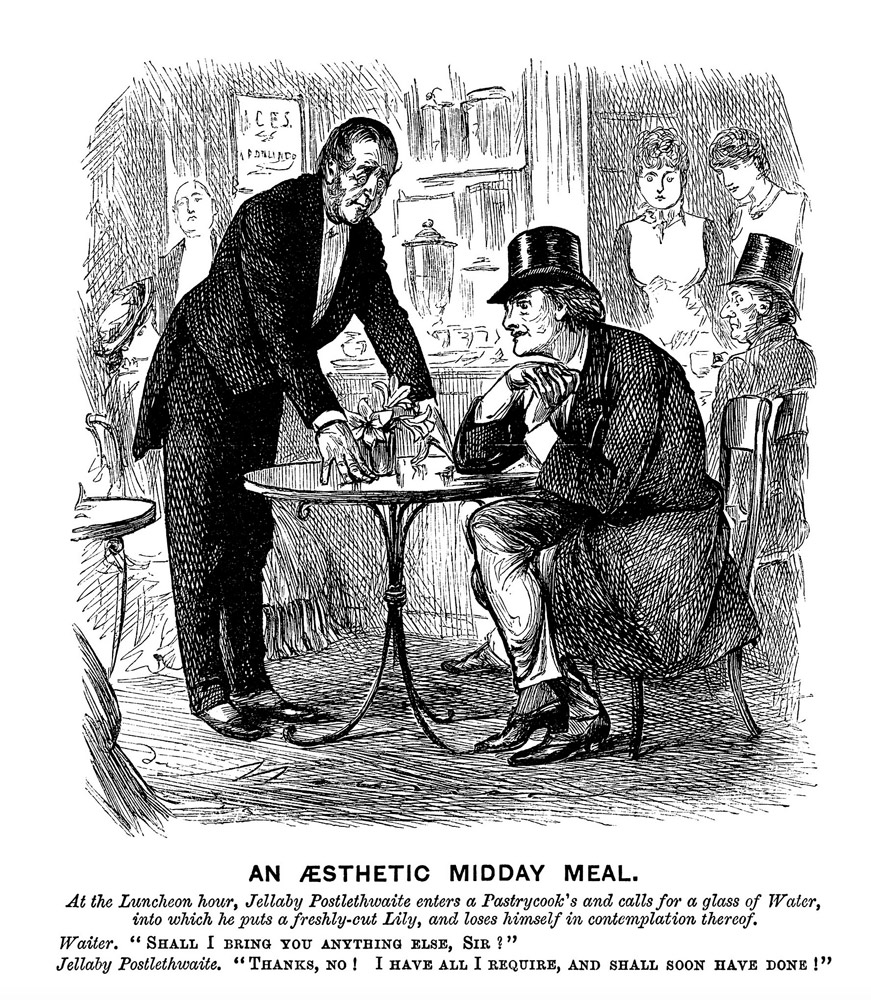
July 17, 1880.
Already a phenomenon, he was interviewed by reporters even before disembarking, and one of his first remarks became instant headline material. As The Sun recorded that day, Wilde quipped, “By the by, do you know, I was very much disappointed in the Atlantic Ocean. It was very tame. I expected it to have some roar about and be beautiful in its storms. I was disappointed in it” (“Wilde’s Comment on the Atlantic”). The line, playfully absurd and self-aware, was gleefully repeated and parodied across the press, even recycled by Wilde himself in reference to Niagara Falls months later. On January 7, 1882, The Pall Mall Gazette printed a poem titled “Idylls of the Dado: The Disappointing Deep.” According to John Cooper, Henry Labouchere’s periodical Truth published a rejoinder expressing the Atlantic Ocean’s disappointment in Wilde. With exchanges like these, the machinery of modern celebrity was set in motion, and Wilde had turned the press into both stage and audience, inspiring laughter, imitation, and fascination in equal measure, playing both provocateur and punchline.
Additionally, the now-famous line supposedly retorted upon his arrival, “I have nothing to declare but my genius,” though likely apocryphal, exemplifies how Wilde’s persona had a life—and afterlife—of its own. It is likely, according to Wilde scholar John Cooper, that the quote originated in Robert Ross’s 1910 The Oscar Wilde Calendar decades later and then was quickly conveyed in Arthur Ransome’s 1914 Oscar Wilde: A Critical Study. As Chris Rojek would argue, Wilde’s celebrity was a “cultural fabrication,” a persona coproduced by Wilde, the press, and the public. Wilde was both subject and object, agent and artifact, exploiting and being exploited by the media machine.
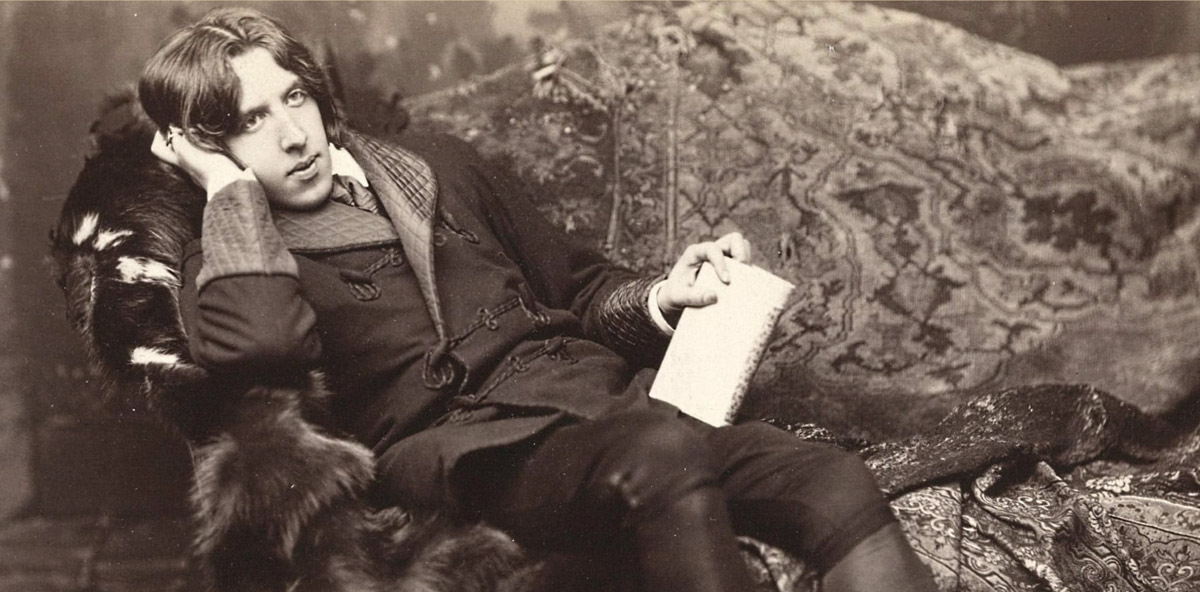
Central to this construction of his image was Wilde’s collaboration with Napoleon Sarony, America’s most renowned portrait photographer, on January 5, 1882. Not long after Wilde’s arrival, in fact, a Times article appeared with the headline “Faces of Noted People. The Popular Craze for Photographs of Celebrities.” The twenty-eight images Sarony produced of Wilde were not mere documentation; they were iconography. Wilde posed deliberately, dressed theatrically, and curated his visual identity with precision. As David Newhoff argues in Who Invented Oscar Wilde?, these photographs circulated widely, becoming the visual shorthand for Wilde’s aesthetic persona and contributing to the commodification of his image. One image, Sarony No. 18, even became the centerpiece of the landmark copyright case Burrow-Giles Lithographic Co. v. Sarony, reinforcing Wilde’s role at the intersection of art, commerce, and law. These portraits did not simply document fame; rather, they defined it. By posing as both artist and artwork, Wilde materialized the feedback loop between image and identity that modern celebrity depends upon.
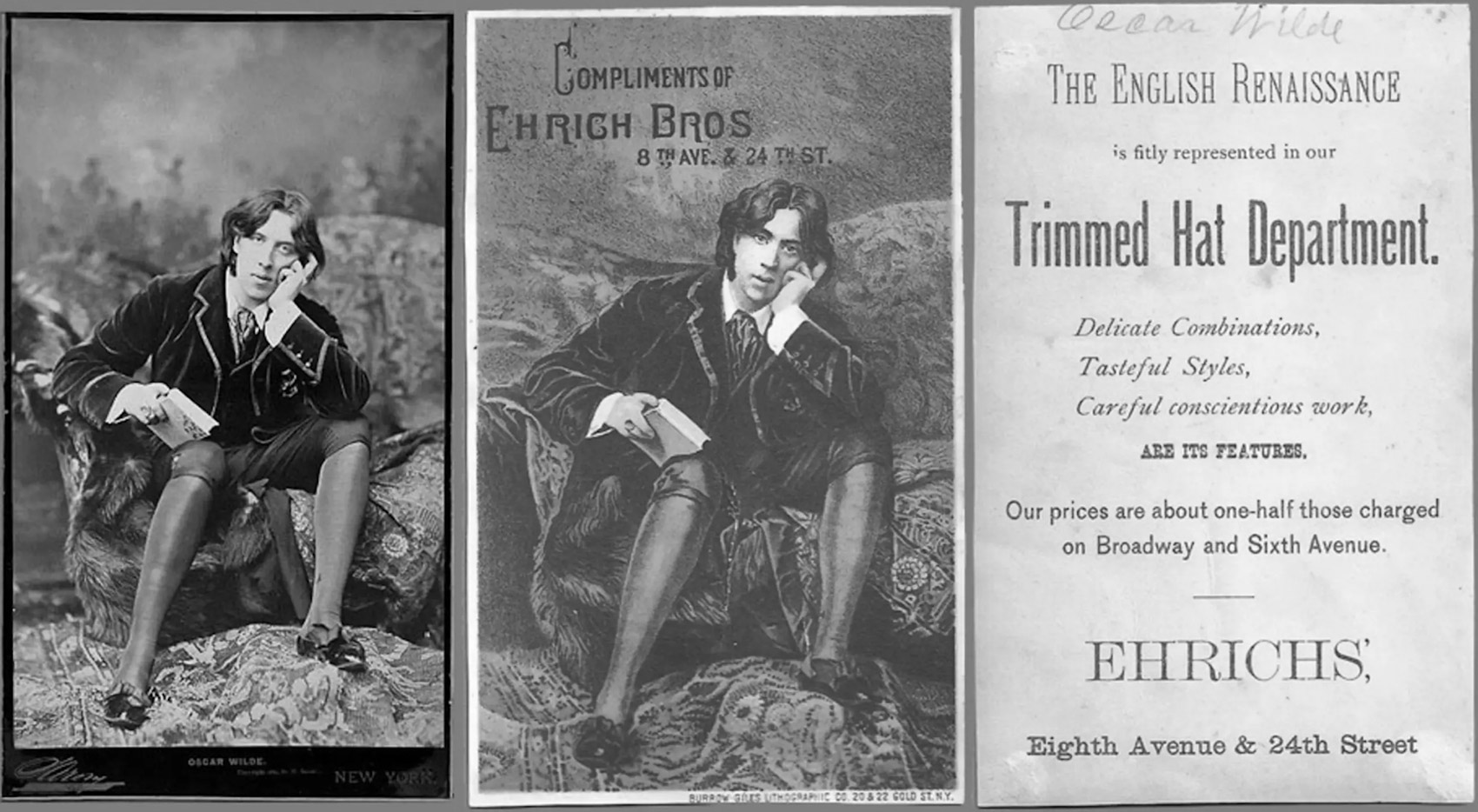
While Wilde was a major event on the media landscape at the moment, he was not the only one. During the previous decades, Dickens had toured America to much fanfare. And the Lyceum Movement had offered other opportunities for lectures by notable public figures as part of adult education and entertainment in America after the Civil War. Another traveling show was also underway: P. T. Barnum had purchased an African bush elephant, Jumbo, from the London Zoo, and he was on tour that year. These two sensations were immortalized together in this cotton thread advertisement, an early example of a celebrity endorsement.
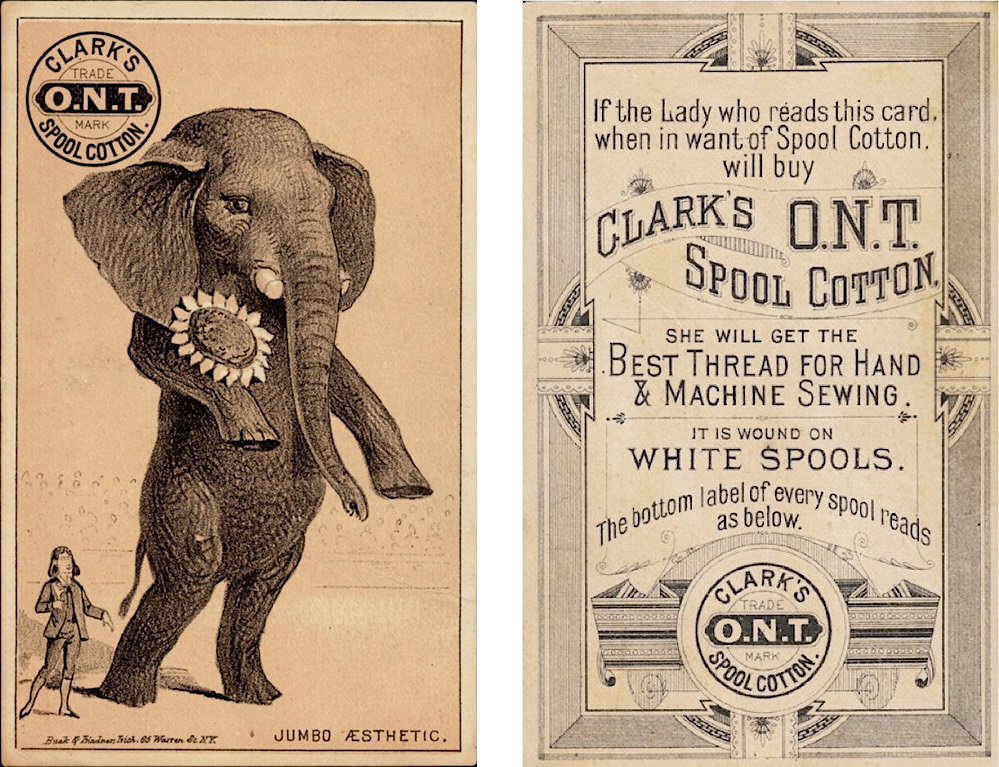
While Jumbo traveled with a circus, Wilde’s caravan was a sort of carnival. Carte’s manager William F. Morse was to take care of promotion and set up the details. And in the South, his manager General Peter Tracy of Memphis, a native of the region, took over. J. S. Vale was hired as his secretary, and there was an advance man, Frank Gray, whose responsibility was to travel ahead to place local advertisements, share images and stories in the press, and drum up interest and sensation in anticipation of Wilde’s arrival. Tales of his velvet breeches, towers of suitcases, and armloads of lilies and sunflowers circulated, and scores of onlookers arrived to see the show when he came to town. Wilde also traveled with his valet, recently identified as Stephen Davenport, who took care of his wardrobe and became a key figure just prior to his Savannah visit.
Wilde’s celebrity was also sustained through his prolific engagement with the press. He sat for nearly a hundred interviews during the tour, embracing a format that was still novel in American journalism. In his interview with The Boston Globe on January 28, 1882, Oscar Wilde himself declared, “Interviewers are a product of American civilization, whose acquaintance I am making with tolerable speed. [. . .] I am always glad to see you. We have no interviewing in England.” As Marcus has noted, the interview became a vehicle for Wilde to perform his persona in real time through offering witty soundbites and quotable provocations that fueled public fascination. Wilde courted his public and the media accordingly in many cases, for as he said in Dorian Gray and elsewhere “There is only one thing worse than being talked about, and that is not being talked about.” Wilde understood that visibility was currency, and he never turned down an opportunity to be seen, heard, and quoted.
In this way, Wilde’s tour functioned as a masterclass in media manipulation. His fame was not the byproduct of artistry but the result of a strategic interplay between performance, publicity, and public desire. The Savannah stop, situated midway through the southern leg of the tour, offers a particularly vivid snapshot of this machinery in motion, where Wilde’s cultivated image met the cultural expectations, anxieties, and hierarchies of a post-Reconstruction southern city.
3Performing Aestheticism in a Southern Key
Wilde’s southern itinerary turned aesthetic diplomacy into cultural negotiation. His June 30 visit to Jefferson Davis at his coastal estate, Beauvoir, in Biloxi epitomized the collision between European aesthetic cosmopolitanism and the South’s myth of the Lost Cause. In his biography Jefferson Davis: Tragic Hero, the Last Twenty-Five Years, 1864–1889, Hudson Strode cites an interview by Lee Meriwether that illustrated how Wilde was campaigning for an invitation in interviews. According to Lee, Wilde praised Davis as “the man I would like most to see in the United States” (459), something he also said of John Keats’s niece and Walt Whitman, nimbly giving the people what they wanted to hear. And Wilde clearly understood that networking with other famous people would only burnish his own celebrity.
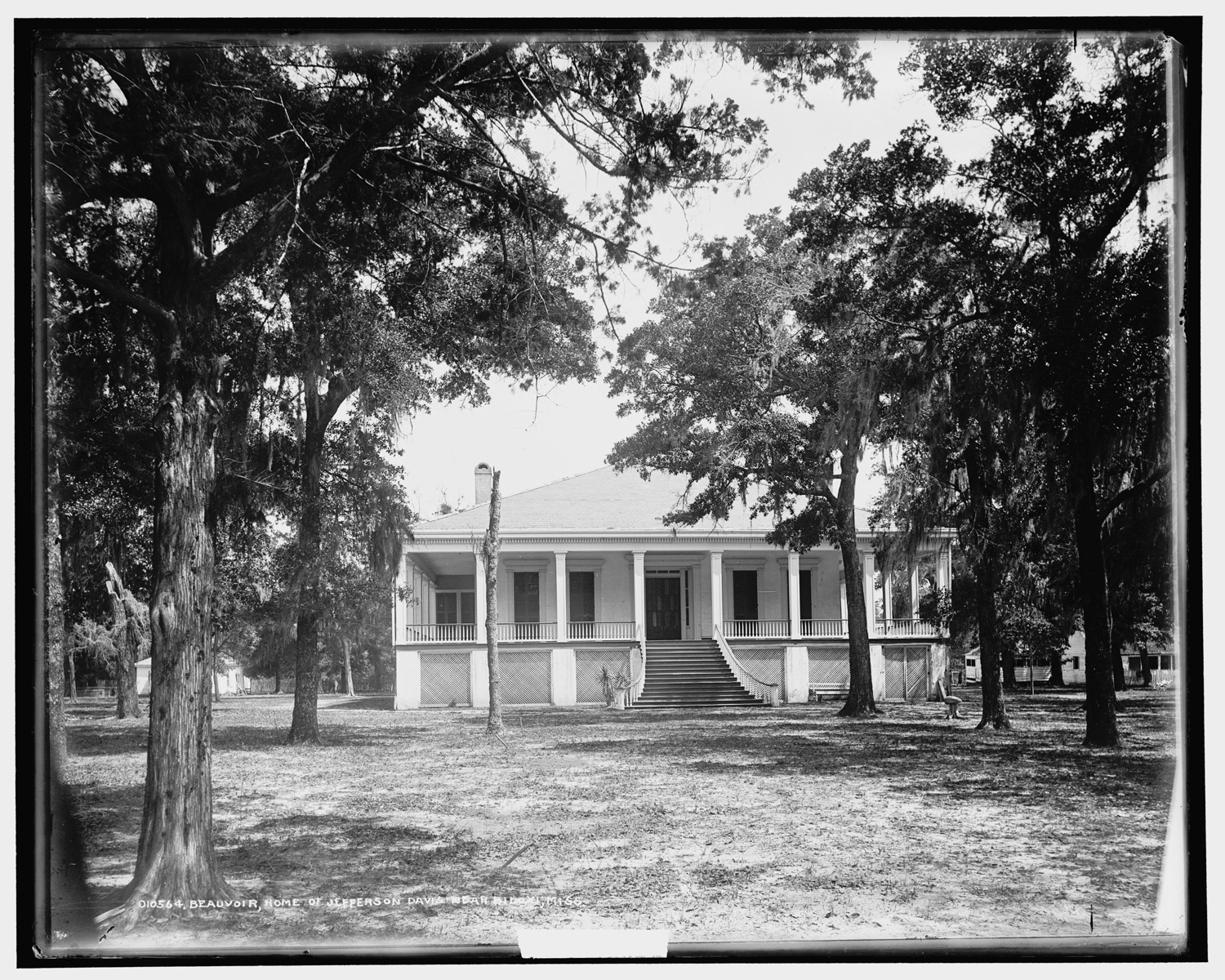
Wilde also praised the scrappiness of the Confederacy, according to Strode, and that “it took Northern armies numbering three million soldiers four years to whip him” (459). He then wrote what he described as a “most winning” letter asking for permission to “pay homage.” And according to Strode in his biography of Davis, it was Davis’s wife, Varina, who convinced him to allow the visit. Strode writes: “At best, Davis did not care for worldly people, nor did he fancy people for their fame” (460). Wilde’s manager shared the news of this detour with the Mobile Register which reported on June 23: “We understand that ex-President Davis has invited Mr. Wilde to pay him a visit at Beauvoir, his Mississippi home; and that the aesthete has accepted. [. . .] It is scarcely conceivable that two persons can be more different than the ex-President of the Confederacy and the ‘Apostle of Aestheticism,’ as known to report; and we confess sufficient curiosity to desire to know the bent of their coming, protracted interview” (460). The New Orleans Picayune, in describing this occasion, found Wilde to have “very sensible views about the Southern Confederacy” (qtd. in Hofer and Scharnhorst 155). Flattery here functioned as public relations as much as conviction. By aligning himself with the South’s fallen hero, Wilde translated rebellion into aesthetic capital, thereby turning the politics of defeat into an emblem of artistic nonconformity.
Wilde continued to situate the visit as a tribute to his allegiance with the underdog in his Picayune interview. He is reported as saying about Davis: “His fall after such an able and gallant pleading in his own cause, must necessarily arouse sympathy, no matter what might be the merits of his plea. The head may approve the success of the winner, but the heart is sure to be with the fallen” (qtd. in Hofer and Scharnhorst 156). While he described this failure in romantic terms, moreover, Wilde compared the plight of the Confederacy with that of the Irish with the British empire: “It was a struggle for autonomy, self-government, for a people. I do not wish to see the Empire dismembered, but only to see the Irish people free. [. . .] [P]eople must have freedom and autonomy before they are capable of their greatest result in the cause of progress. This is my feeling about the southern people as it is about my own people, the Irish. I look forward to meeting Mr. Jefferson Davis” (qtd. in Hofer and Scharnhorst 157). This romantic alignment of lost causes and national struggles set the tone for Wilde’s visit to Beauvoir, where his aesthetic diplomacy met the stern dignity of the Confederate patriarch.
Yet beneath this exchange of formal courtesies unfolded a quiet duel of masculinities. As Hudson Strode records, the feeling was not mutual: Davis “felt something indefinably objectionable” about his guest (460–61). He found the inscribed book Wilde left him “presumptuous,” spoke little at dinner, and excused himself early (Morris 184). Writing a few days later—likely from Savannah on July 6, 1882—to Julia Ward Howe, author of “The Battle Hymn of the Republic,” Wilde offered his own, more theatrical account:
I write to you from the beautiful, passionate, ruined South, the land of magnolias and music, of roses and romance: picturesque too in her failure to keep pace with your keen northern pushing intellect; living chiefly on credit, and in the memory of some crushing defeats. And I have been to Texas, right to the heart of it, and stayed with Jeff Davis at his plantation (how fascinating all failures are!) and seen Savannah, and the Georgia forests, and bathed in the Gulf. (qtd. in Rogers 482)
Clearly, Wilde understood the South as something unique and something to romanticize or aestheticize. And while Davis embodied the stoic self-command of the Lost Cause, Wilde, by contrast, redefined mastery through wit, poise, and aesthetic self-control. Each man staged authority through style—Davis through moral gravity, Wilde through ironic elegance—turning civility itself into theater. Their meeting revealed how the South’s code of honor could accommodate, but never fully contain, the modern spectacle of celebrity.
The fault lines exposed at Beauvoir widened in Atlanta, where Wilde lectured on July 4, 1882, amid patriotic celebration and press scrutiny. His velvet and lace provoked fascination and laughter in equal measure; yet the most telling episode of his Georgia visit did not occur on stage but on the train to Savannah.
It would be easy to conclude that Wilde’s affinity with the South was also a product of the racism predominant at this moment in history. He never spoke for or against slavery, segregation, or Jim Crow. From the train during his southern travels, it is said he witnessed a lynching with no reported comment. In a January 1882 letter to Norman Forbes-Robinson, he referred to his servant as a “slave” (Holland and Davis 127). And he no doubt romanticized the racial situation in the South. In a letter to Howe, he described engaging “in Voodoo rites with the Negroes” (Holland and Davis 175). Moreover, in his June 25 New Orleans Picayune interview, he stereotyped Black people he encountered as “happy and careless, basking in the sunshine or dancing in the shade, their half-naked bodies gleaming like bronze. [. . .] I am surprised that painters and poets have paid so little attention to them, particularly to the Negro, as a subject of art” (qtd. in Morris 179). Wilde’s southern sympathies were also shared by the racial ideologies that underwrote post-Reconstruction society and his picturesque descriptions of Black bodies as artistic subjects reveal how aesthetic discourse could sanitize the brutality of racial hierarchy.
On July 6, The Atlanta Constitution published an article titled “Oscar Wilde’s Valet,” recounting how Wilde’s Black servant was denied a berth on the sleeping car despite Wilde’s protests. According to the report, when Wilde’s agent purchased three first-class and three sleeping-car tickets, a railway official “informed the agent that it was against the rules of the company to sell sleeping-car tickets to colored persons.” It was widely reported in The New York Times, the Atlanta Constitution, and many media outlets that Wilde explained “he had never been interfered with before,” and they would retain their tickets. Thweatt then enlisted the porter, Steve Henderson, to speak to Davenport himself, and he is reported to have “told him that the train would go through Jonesboro, and if the people saw a negro in the sleeper they would mob him” (“Oscar Wilde’s Valet”). This appeal resulted in the ticket being returned in exchange for a second-class ticket.
This incident, in which the valet is not mentioned by name, illuminates the racial boundaries that framed celebrity in the post–Reconstruction South. The Constitution’s matter-of-fact tone in reporting segregation as routine and intimidation as pragmatic reveals how deeply racial violence structured the social world Wilde traversed. His cosmopolitan ideals of beauty and equality encountered in Georgia the coercive power of custom. As Bonnie Carr O’Neill has shown, nineteenth-century publicity was organized around hierarchies of visibility; some bodies were made spectacles, others rendered invisible. On the way to Savannah, Wilde’s celebrity confronted those limits directly. His own performance of aesthetic individuality collided with a system that defined civility through racial exclusion.
The sleeping-car dispute thus becomes more than a local anecdote: It marks the point where Wilde’s experiment in aesthetic cosmopolitanism met the hard edges of Jim Crow modernity. His insistence that his valet be treated as an equal guest dramatized the tension between the universalism of art and the parochialism of southern race codes. Now, this was no Rosa Parks scene, but Wilde’s perceived progressive moment of advocacy was notable enough to be widely reported across the country. Clearly, Wilde did not align the values of the Confederacy or his personal values with respect to race in a consistent way. The episode, quietly reported and quickly forgotten, offers a rare glimpse of Wilde not only as performer but as witness: an international celebrity momentarily powerless before the racial logic that governed the very society enthralled by his spectacle. In the mirror of the South, Wilde glimpsed the truth of modern fame; No artist, however artful, could fully command that gaze that made him visible. His image, reflected through the racial and social hierarchies of the post–Reconstruction South, revealed the price of being seen.
4On Stage in Savannah: Lecture and Local Response
The Savannah public was engaged with the figure of Oscar Wilde from the moment of his arrival on American soil. In fact, on January 24, 1882, just a few weeks after he arrived stateside, someone named Jessamine posted a letter to the editor of the Savannah Morning News countering any negative press she had encountered by declaring him “a real genius, and would like he would visit Savannah. Have we no aesthetes to invite him hither?” Her wish came true six months later.
Halfway through his sojourn through the South, on Wednesday, July 5, 1882, Oscar Wilde swept into Savannah, arriving by train on the Central of Georgia line from Atlanta and Macon upon the invitation of the St. Andrew’s Society, a fraternal, social, and philanthropic organization of Scottish origins founded in 1734 and chartered in 1824. While, initially, we may be surprised the Irish Hibernians weren’t the hosts, given the strength of the Irish population there and Wilde’s homeland, according to the History of the St. Andrews Society of Savannah, the organization had sponsored a lecture series in 1881 to raise money for a building (St. Andrew’s Society). A previous speaker, Wallace Bruce, spoke on Scottish themes earlier in the year without raising many funds, so perhaps Wilde was secured to fill the coffers. On this temperate 78-degree day, Hugh F. Train, president of the Society registered Wilde at the Screven House at 1 East Congress Street, which had been built in 1854 based on the design by architect Charles Sholl and was remodeled in 1857. It was reported that in his travels Wilde stayed in the best hotels in each town, so he would have expected first-class accommodations.
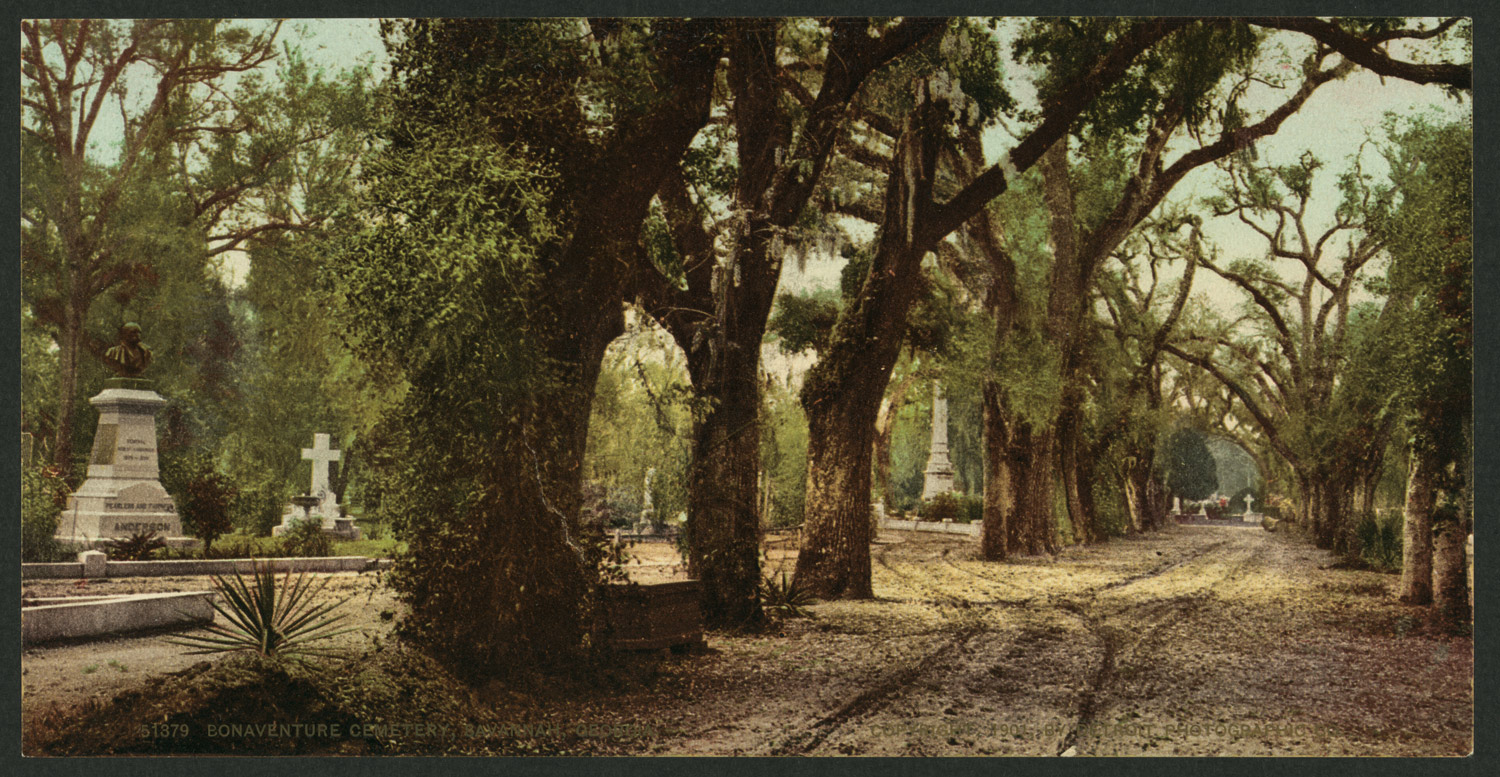
Upon his arrival, he toured Bonaventure and Shell Road and described the sights on his tour as “incomparable.” Some say he praised the sunflowers, an icon of aestheticism, but that is just one of a number of attributions that have come to be apocryphally quintessential Wilde. On that July evening, Wilde arrived at the Savannah Theatre on Chippewa Square for his 8:30 pm lecture on the decorative arts. The Savannah Theatre, originally built in 1818 and based on William Jay’s design, would be the oldest theatre of the 140 in which he spoke in America. Wilde stepped on the stage in his cutaway coat, white vest, ruffled shirt, and velvet knee breeches with no introduction and launched into his talk to a full theatre.
The lecture itself was one of three variations Wilde developed for his American tour. In January, he opened one entitled “The English Renaissance,” something developed in December and then fine-tuned during his sea voyage for his debut in New York. He abbreviated this talk on the decorative arts for a broader audience by focusing on art in everyday life. In the opening of the lecture, he declared to his American audience: “I find what your people need is not so much high imaginative art, but that which hallows the vessels of every-day use” (4). Later, he extended this line of thinking in crafting an additional lecture, “House Beautiful.” According to William Warren Rogers, we could characterize these lectures as both “scholarship and showmanship” (481). Savannah offered an ideal stage for this blend of pedagogy and performance, where refinement and spectacle could coexist under the banner of culture.
In terms of the lecture itself, Wilde was progressive aesthetically, defying the traditional Victorian art academicians like Sir Joshua Reynolds for the Pre-Raphaelite Brotherhood and their purer, truer, more authentic, and perhaps raw form of art. He rejected mass-production and commercialism—ironically, perhaps, given how commercial he himself proved to be—for the intensity of Walter Pater and the craftsmanship espoused by William Morris or John Ruskin. In this way, he celebrated what he called “handicraftsman” and contends that “[t]he mark of all good art is not that the thing done is done exactly or finely, for machinery may do as much, but that it is worked out with the head and the workman’s heart” (4–5). His respect of art for art’s sake as opposed to the didactic morality of his fellow Victorian novelists was viewed as shocking to many. His argument was that the purpose of art was to intensify experience and one should prioritize the artistic experience in every aspect of life, from personal dress to home decor. He asserts: “Art is not something which you can take or leave. It is a necessity of human life” (4). Aestheticism was the popularized version of this kind of artistic philosophy, and in this lecture, he aimed to explore art for everyone. Moreover, he goes on to reject the centrality of the salesman for “nobility” of the workman (13). For Wilde, craft and beauty is of educational value: “If children grow up among all fair and lovely things, they will grow to leave beauty and detest ugliness” (13–14). By recasting aestheticism as moral discipline, Wilde translated avant-garde art into a language of virtue, an approach that made his message palatable to southern propriety, concluding his lecture with “[w]hat we want is something spiritual added to life. Nothing is so ignoble that art cannot sanctify it” (15).
The Savannah Morning News reported the following day, on July 6, 1882, that “[t]he audience which filled the Theatre last evening was composed of the best class of our citizens.” Audience composition itself signaled the negotiation of class and culture: The city’s elite attended to both display refinement and to domesticate the stranger’s previously reported flamboyance. However, Wilde’s intended audience could be understood as broader. His lecture recast aestheticism as moral discipline as the reviewer reported: “He preaches the doctrine, that the good, the substantial, the truly elegant should enter into the fabric of our social life. And what he says is not merely for the benefit of the rich and the indolent; it is in the interest of the working class.” That moral framing—art as social virtue rather than indulgence—resonated with Wilde’s own remarks published the same morning in The Atlanta Constitution:
The South should be the home of art in America, because it possesses the most perfect surroundings. Now that it is recovering from the hideous ruin of the war, I have no doubt that these beautiful arts, in whose cause I will spend my youth in pleading, will spring up among you. [. . .] The very physique of the people in the South is far finer than that in the North, and a temperament infinitely more susceptible to the influences of beauty. (“Oscar Wilde: Arrival of the Great Esthete”)
Wilde would go on to flatter the South: “You have two perfect essentials for cultivation of high art: beautiful flowers and beautiful women. If these things don’t affect you, you are lost to sensibilities.” Yet this gallant praise did little to soften the skepticism of Savannah’s critics.
5Courteous Coverage: The Hostess City and the Southern Press
Wilde’s departure did not end his Savannah performance; it transformed into a contest over interpretation, becoming a mirror in which the city measured its civility. In parlors and newspapers, citizens replayed the question his visit posed: Could southern gentility embrace cosmopolitan taste without surrendering moral authority? That brief encounter condensed the region’s broader struggle to reconcile aspiration and anxiety, refinement and restraint.
In their review that morning after his Savannah lecture, the Savannah Morning News praised the classiness of the crowd but could not resist a mild aside about the “grotesque dress” of the lecturer: “the long hair, ridiculous postures, the drawling voice and the miserable elocution must be forgotten.” In other words, Savannah’s press did not merely report on Wilde, it interpreted him, translating his velvet aesthetic into the idiom of regional propriety. This critic’s commentary is illustrative of the pains with which he had to euphemize to criticize the identity of the person and his reluctance to praise the content of the lecture because of that identity. The critic admitted that the “desire to see and hear him was general” and “the audience gave respectful attention to the lecture.” However, he could not help but satirize Wilde, mocking the “too-too” and “utterly utter” through his exaggerated use of alliteration. The review’s tone reveals the critic’s balancing act: Compelled to acknowledge Wilde’s eloquence yet constrained by propriety, he couched discomfort in euphemism and humor.
The Morning News thus framed Wilde’s appearance as a test of Savannah’s refinement. Praising his eloquence and clear exposition of the beautiful in daily life, the reviewer quickly re-anchored that praise in moral reassurance: “Oscar Wilde, who has achieved such notoriety as the apostle of aestheticism . . . was received with pleasure.” This rhetorical containment allowed readers to consume Wilde’s flamboyance as spectacle while preserving the city’s own decorum. The critic reluctantly noted that the discourse itself “could be read with infinite pleasure and profit . . . and we are sure the intelligent audience appreciated it and were well pleased,” so the problem was with the persona. As Richard Dyer’s notion of the “structured polysemy” of the star image suggests, Wilde could be presented simultaneously as teacher of taste and object of curiosity (3). By emphasizing that his lecture promoted household virtue, the News recoded aestheticism into a domestic key, making it safe for the parlor. The article thus turned Wilde’s challenge to bourgeois morality into its very affirmation, an act of what Tom Mole terms triangulation, where celebrity, media, and audience co-produce meanings acceptable to local norms (1).
In Savannah, the press acted as intermediary, ensuring that Wilde’s foreign sophistication was appreciated but never uncritically admired. Even, the Waynesboro True Citizen, a small Georgia weekly, remarked that the Savannah paper was “very severe on Wild Oscar” (qtd. in Rodgers 482).
The press’s ambivalence was soon countered in private correspondence. On July 6, Mrs. Mary Bulloch of Savannah, a doctor’s wife, a Savannah socialite, and a member of Christ Church, wrote directly to Wilde, apologizing for the press’s “silly rudeness” and insisting that “the leading minds of our little city” held the opposite view (qtd. in Rodgers 484–85). Her letter performs a social correction by discrediting public ridicule while validating Wilde’s artistry. She attributes the hostile review to “chagrin”—a failure of discrimination—thus casting aesthetic discernment as the privilege of cultivated taste. Her offer to host Wilde and to have him mentor her son transforms apology into inclusion, reclaiming Wilde as a figure of refinement aligned with Savannah’s elite. The episode reveals celebrity as a negotiation between public spectacle and private validation with the newspaper enforcing conformity, the drawing room asserting cosmopolitan distinction.
Another Savannahian, Jane Judge, recorded her “Personal Impressions of Literary Persons who have visited Savannah from 1882 to the Present Day” and remembers the “Oscar Wilde craze” sweeping the city asserting her “house hummed with it.” She too reflects on “the ridicule and the defense” his visit incited and recounts: “The new ideals of beauty caused the same excitement then, and gave us the same thrill and provoked the same quarrels that every restatement of the gospel of beauty and every attempt to express it in terms for a generation evoke.” She goes on to suggest that his unconventionality provoked a reactionary defense prior to the visit but the review after “nobly eats crow” in admitting some of the value of what Wilde actually had to say. Private correspondence like these reveals a secondary, gendered counterpublic of reception where women reframed Wilde’s aesthetic performance as moral education and social refinement.
Wilde’s personal impact on his publics were evident elsewhere in Georgia at the Foster-Thomason-Miller-Minnix House in Madison, Georgia. After a fire burned the building that housed the Georgia Female Academy in 1880, Legare H. Foster purchased the eleven-acre lot and built a five thousand-square-foot mansion on the site. Design features of the building were modeled after the Aesthetic movement, as it is surmised that Foster became enamored with the style after attending the “House Beautiful” lecture in Atlanta the evening before the Savannah event. This offers yet another example of that essential element of celebrity described by Rojek, “the impact on public consciousness” (10). This spectrum of treatments—from earnest praise to urbane irony, from cutting criticism to genteel omission—extends Wilde’s one-night performance into a civic meditation on taste and identity. The press coverage and reception of that coverage then became what Marcus terms a “secondary stage,” where readers rehearsed their own roles as arbiters of culture. Through both derision and admiration, Savannah’s press rehearsed its own cultural self-image. Wilde’s visit became an allegory of civility—an experiment in how far southern refinement could stretch without cracking.
6When Civility Cracks: The Shadow Side of Celebrity
If Savannah’s civility masked unease, that unease erupted nationally in caricature. Wilde’s gender performance exposed the fragility of postbellum masculinity and its entanglement with racial hierarchy. Reporters admired his eloquence yet mocked his manner, struggling to reconcile aestheticism with regional ideals of manhood.
In post–Civil War America, the nature of masculinity was renegotiating itself—no longer defined by the soldier’s identity but by new cultural figures such as the cowboy or frontier showman. Against that backdrop, Wilde’s aesthetic poise seemed both foreign and provocative. Interviewers, not unlike the Savannah critic, repeatedly commented on his “womanly air,” “thick locks of brown hair,” “lisp,” “effeminate voice,” and “feminine way,” describing his features in elaborate detail throughout the 1882 tour (qtd. in Hofer and Scharnhorst 5). This vocabulary of fascinated ridicule reflects what Dyer calls the “structured ambiguity” of stardom: Wilde’s presence allowed the southern press to test the boundaries of gender while reaffirming its own codes of civility. Rojek’s notion of celebrity as “cultural fabrications” helps explain the exchange: Wilde exaggerated refinement to parody the very restraint southern manhood idealized (10). For Savannah’s spectators, that ambiguity offered both moral reassurance and comic relief, a safe way to confront the instability of their own ideals of manhood. Moreover, Savannah’s laughter at his attire masked anxiety about masculinity itself. To mock the aesthete was to reassure oneself that gentility could remain virile. What could be understood as genteel irony in Savannah would metastasize in the national press into grotesque parody.
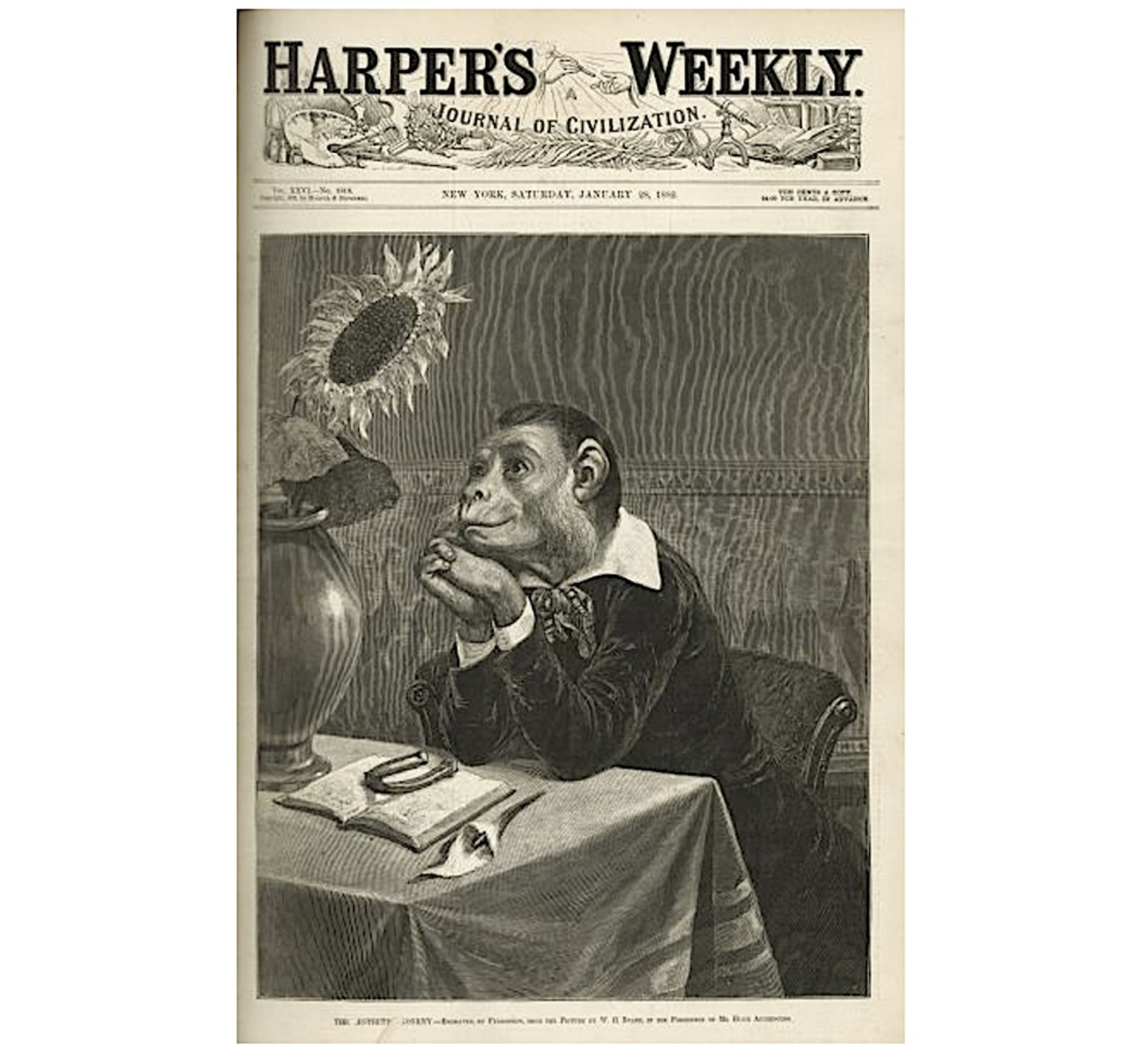
While Savannah’s newspapers could be perceived as treating Wilde with some restraint, the visual and rhetorical codes shaping their readers’ perceptions were already circulating in far more virulent forms nationally. Nationally, that ambivalence hardened into caricature. As Victoria Dailey shows in “The Wilde Woman and the Sunflower Apostle: Oscar Wilde in the United States,” Wilde became the object of a vast visual campaign that merged aesthetic ridicule with racialized insult. Just after his tour began, Harper’s Weekly published William Holbrook Beard’s The Aesthetic Monkey, depicting a monkey adorned with a sunflower, lily, and horseshoe—a grotesque parody of Wilde’s emblems. Dailey argues that this image “inaugurated an avalanche of derogatory, disdainful, and satiric images” that “set the tone for many of the vicious caricatures to come.”
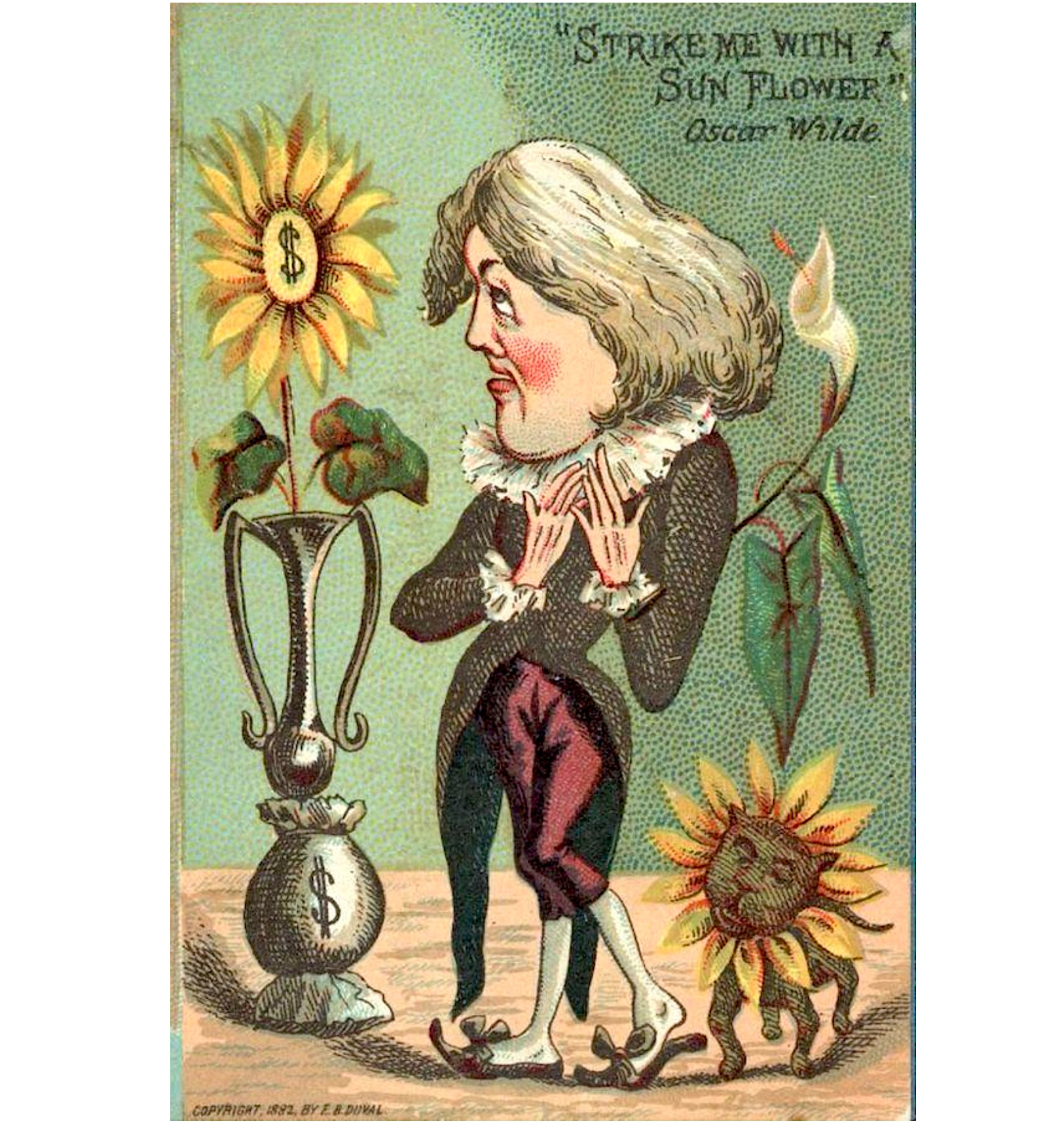
As Wilde’s fame spread, “artists and illustrators began to create caricatures of him, launching a mini-industry that included sheet music, advertising trade cards, photographs, Currier & Ives prints, and newspaper cartoons” (Dailey, “The Wilde Woman”). Commercial entrepreneurs capitalized on his image as aggressively as critics did, producing everything from wallpaper patterns to paint colors under the banner of the “aesthetic craze.” Even Savannah echoed this trend in an ad published weeks after the lecture: A Broughton Street purveyor employed Wilde’s “failure” as a lecturer in a ploy to sell men’s trousers, thus, joining the national commodification of his persona.
Yet many of these images turned commercial play into racist aggression. The new color lithography of the 1880s—so often used to infantilize and animalize Black Americans—was repurposed to humiliate Wilde. “African Americans, the ultimate outsiders,” Dailey observes, “were the easiest people to mock and humiliate in late 19th-century America, and Oscar Wilde joined their ranks.” In caricature he appeared as a Black man, a Black woman, a child, or an ape—his Irishness and aestheticism conflated with racial otherness. The cabinet card The Wilde Woman of Aiken (issued after his Augusta lecture, the night following his lecture in Savannah) transformed him into a southern Black woman; another, Mr. Wild of Borneo, portrayed him as a caricatured African man. Each image compounded insult with dysphemism, mocking both Wilde and the racial “outsiders” his likeness evoked. These images performed a double work of containment, neutralizing Wilde’s gender transgressions by translating them into racial difference. In doing so, they reaffirmed whiteness as the ground of civility.
As Marcus notes, such humor depends on “mingling the rarified with the base—the lily and the sunflower with a pig, a mug, and a jar labeled ‘for sale’” (167). The joke equated aesthetic aspiration with social transgression, inviting laughter at the imagined collapse between the celebrity and the abject figures who “strive and fail to imitate him” (167). This mingling of refinement and degradation turned Wilde into a proxy for anxieties about class, gender, and racial boundaries. Even as captions dismissed the “African American Oscar” as wildness needing cure or quarantine, they betrayed a fear that the aesthete’s self-fashioning might inspire ordinary people—Black and white alike—to dissolve old social bonds and form new ones. The polite irony of Savannah’s media reception thus shared a genealogy with these national caricatures: Both turned ridicule into a defense of order.
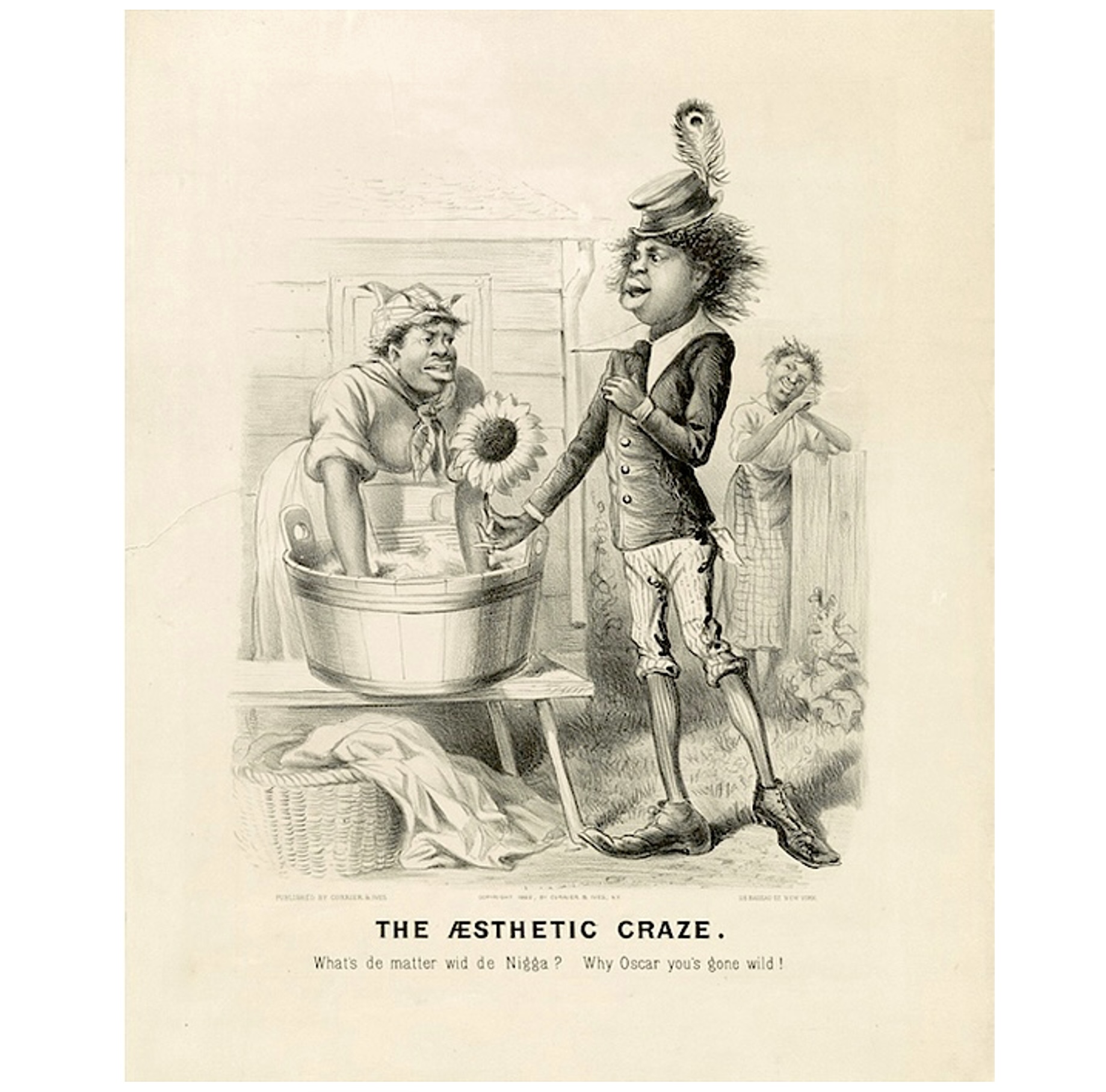
Upon arriving in Charleston from Savannah and Augusta, a Charleston News and Courier reporter observed in his interview that he’d seen “a number of colored women in the Fourth of July parading through the streets with huge sunflowers in their dresses and hats” (qtd. in Hofer and Scharnhorst 164). Wilde didn’t take the bait, replying, “To love one’s life is to love the beautiful” (qtd. in Hofer and Scharnhorst 164). In fact, he had characterized the satirists, née haters, in this way, as reported in the Tribune on January 7, and then the Atlanta Constitution the next day: “This is the compliment that mediocrity pays to those that are not mediocre” (“The Esthete Talks”). By appearing unruffled under scrutiny, he embodied what Rojek terms the “attributed celebrity”—one whose fame depends less on accomplishment than on visibility and control of image (18). This Charleston moment distills the logic of containment: Wilde’s calm wit reframed ridicule as poise, converting surveillance into self-command.
The polite irony of the Morning News and the private warmth of Mary Bulloch’s letter reveal a culture negotiating its self-image through civility, even as the threat of change and difference hovered just beneath the surface. Seen through this lens, Savannah’s restraint appears as a regional adaptation of the same containment impulse visible in national caricature. Where Puck and Harper’s Weekly weaponized ridicule, Savannah transmuted it into gentility. Both forms of response disciplined the spectacle of difference. To laugh at Wilde’s “singular costume” was to reaffirm civility as the property of whiteness and masculinity and to remind readers that even aesthetic rebellion, in the South, had to pass through the etiquette of control.
7Conclusion
Wilde’s southern passage—from Beauvoir to Atlanta and from Savannah to Charleston—reveals celebrity not as a private possession but as a cultural negotiation, shaped by intersecting hierarchies of gender, class, and race. In Savannah, these tensions reached their most intricate expression. The aesthete mirrored the city’s aspiration to gentility even as he exposed its fragility, performing both guest and provocation on what the South called its “hostess” stage.
Tom Mole’s triangulation among celebrity, media, and audience takes on a regional accent here: the exchange between a cosmopolitan performer, a local press bound by civility, and an audience schooled in honor and hierarchy. Through both performance and reportage, Savannah helped script the modern drama of fame, proving that even an international icon depended on local acts of recognition. Boorstin’s notion of being “well known for being well known” acquires in Savannah a distinctly southern inflection: The Morning News, in its civility and caricature alike, turned Wilde into a mirror for its own refinement and unease.
In that mirror, the South rehearsed its passage from post-Confederate nostalgia to cosmopolitan aspiration. Wilde found in Savannah an audience eager to see itself reflected in art; Savannah found in Wilde a means to perform its rebirth. Each staged the other into being, a collaboration that still echoes in the intertwined performances of celebrity, civility, and self-display today.
Notes
- Boorstin, Daniel J. The Image: A Guide to Pseudo-Events in America. Vintage, 1961.
- Burrow-Giles Lithographic Co. v. Sarony, 111 U.S. 53 (1884).
- Cooper, James. “Oscar Wilde in America: A Resource of Oscar Wilde and His Visits to America.” Accessed February 2026. www.oscarwilde.us.
- Dailey, Victoria. “The Wilde Woman and the Sunflower Apostle: Oscar Wilde in the United States.” Los Angeles Review of Books, February 8. 2020. https://lareviewofbooks.org/article/the-wilde-woman-and-the-sunflower-apostle-oscar-wilde-in-the-united-states/
- Dyer, Richard. Stars. BFI Publishing, 1990.
- “The Esthete Talks, and Finds Fault with His Critics: A Talk with the Social Humbug of England.” Atlanta Constitution. ProQuest Historical Newspapers, January 8, 1882: 2.
- “Faces of Noted People. The Popular Craze for Photographs of Celebrities.” New York Times, February 25, 1883: 6.
- Friedman, David. Wilde in America: Oscar Wilde and the Invention of Modern Celebrity. Norton, 2014.
- Hofer, Matthew, and Gary Scharnhorst, eds. Oscar Wilde in America: The Interviews. University of Illinois Press, 2010.
- Holland, Merlin, and Rupert Hart-Davis, eds. The Complete Letters of Oscar Wilde. Henry Holt, 2000.
- “Idylls of the Dado: The Disappointing Deep.” The Pall Mall Gazette. The British Newspaper Archive, January 7, 1882: 4.
- “Interview.” Atlanta Constitution, ProQuest Historical Newspapers, July 5, 1882.
- Judge, Jane. “Personal Impressions of Literary Persons Who Have Visited Savannah from 1882 to the Present Day.” Savannah Historical Research Association Collection, no. 994, folder 50. Georgia Historical Society, Savannah.
- Marcus, Sharon. The Drama of Celebrity. Princeton University Press, 2019.
- Mole, Tom. Byron’s Romantic Celebrity: Industrial Culture and the Hermeneutic of Intimacy. Palgrave Macmillan, 2007.
- Morris, Roy. Declaring His Genius: Oscar Wilde in North America. Harvard University Press, 2013.
- Newhoff, David. Who Invented Oscar Wilde? The Photograph at the Center of Modern American Copyright. Potomac Books, 2020.
- O’Neill, Bonnie Carr. Literary Celebrity and Public Life in the Nineteenth-Century United States. University of Georgia Press, 2017.
- “Oscar Wilde and Aestheticism.” New York Sun. Library of Congress, January 1, 1882: 4.
- “Oscar Wilde: Arrival of the Great Esthete and his Lecture.” Atlanta Constitution. ProQuest Historical Newspapers, July 6, 1882: 8.
- “Oscar Wilde’s Valet.” Atlanta Constitution. ProQuest, July 6, 1882: 7.
- Rogers, William Warren. “In Defense of Oscar Wilde: Mary E. Bulloch on His Savannah Appearance in 1882.” Georgia Historical Quarterly 74, no. 3 (1990): 475–85.
- Rojek, Chris. Celebrity. Reaktion Books, 2001.
- Savannah Morning News. Advertisement. ProQuest, July 4, 1882.
- Savannah Morning News. “Letter to the Editor.” ProQuest, January 24, 1882.
- Savannah Morning News. “Review: Oscar Wilde at the Theatre.” ProQuest, July 6, 1882.
- St. Andrew’s Society of the City of Savannah. History of the St. Andrew’s Society of the City of Savannah. Braid & Hutton, 1921.
- Strode, Hudson. Jefferson Davis: Tragic Hero, the Last Twenty-Five Years, 1864-1889. Harcourt Brace, 1964.
- Wilde, Oscar. Decorative Art in America: A Lecture. Cincinnati: Brentano’s, 1906. Digitized by the Cincinnati & Hamilton County Public Library, Genealogy & Local History Department. http://classic.cincinnatilibrary.org/record=b3248620~S1.
- Wilde, Oscar. “[Interview].” Boston Globe. ProQuest, January 28, 1882.
- “Wilde’s Comment on the Atlantic.” New York Sun, January 3, 1882. In James Cooper, editor, Oscar Wilde in America, www.oscarwildeinamerica.org/quotations/disappointed-in-the-atlantic.html.
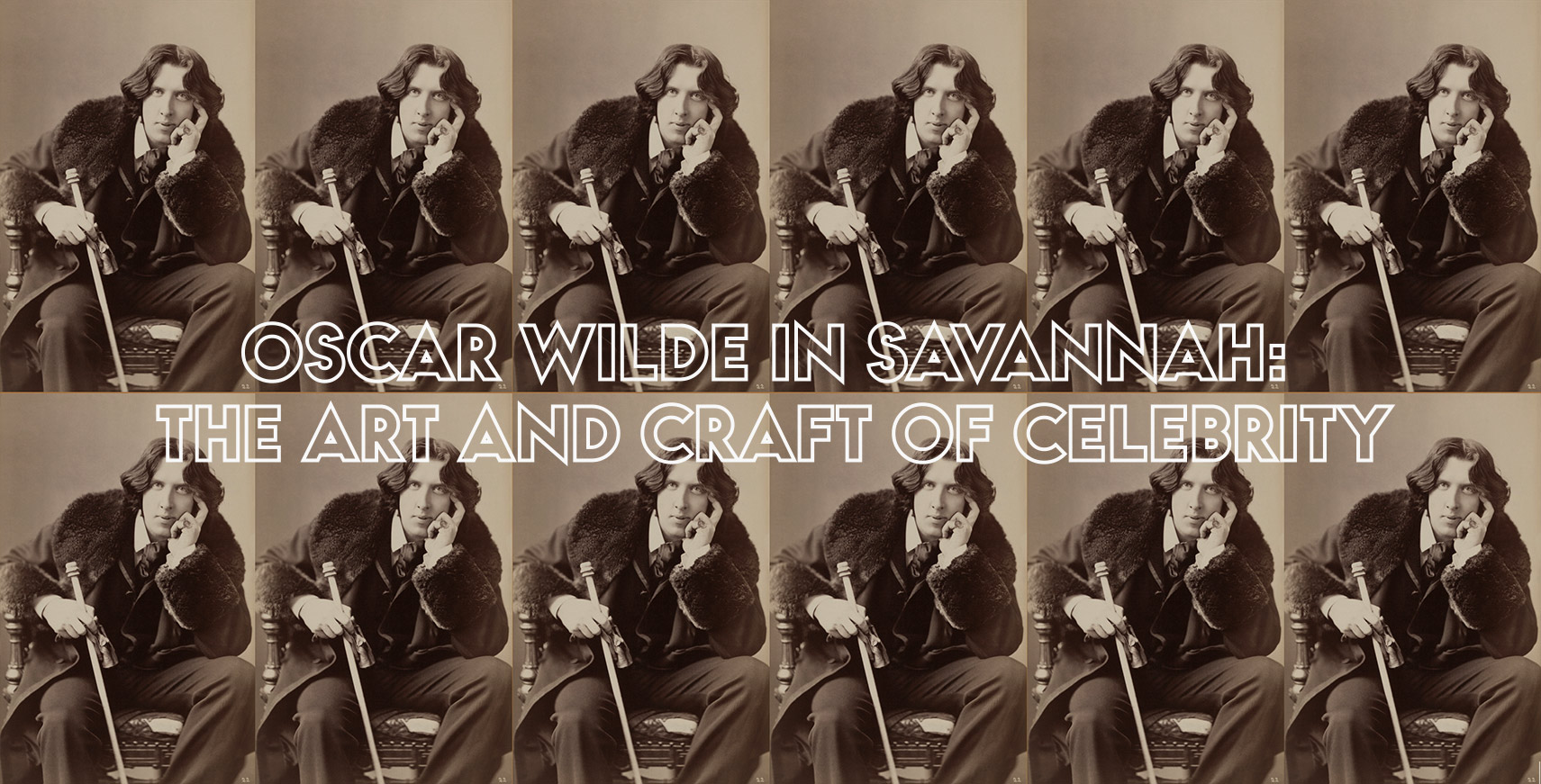
- Banner image credit: Photo of Oscar Wilde by Napoleon Sarony (Albumen print on card mount, sheet 30.6 x 18.4 cm, on mount 33 x 19 cm. Notes 1045. U.S. Copyright Office. Title from item. No. 22.)