

1Introduction
Until quite recently, the exhibition of women’s literature at the 1884 New Orleans World’s Fair was in danger of being forgotten. In fact, one influential study declared the 1893 Woman’s Building library from Chicago’s Columbian Exposition “the first documented collection of women’s books gathered by women, as far as anyone knows.”1 Hence our project: This Beautiful Sisterhood of Books, an interactive digital archive that recovers the 1884 Woman’s Literary Exhibit for new audiences. We know this library existed (nine years before Chicago’s) because it is documented in the 1885 Report and Catalog of the Women’s Department left by Woman’s Department President, Julia Ward Howe. This report includes a shelf list prepared by Julia’s daughter, Maud, who came to New Orleans to oversee the department’s Literary Exhibit. Maud’s list tells us that the original library comprised 1,400 items, diverse in subject and genre. Novels, short fiction, poetry, and children’s literature were all represented, along with scientific studies; medical treatises; works on political economy; architectural handbooks; guides for practicing physiognomy, beekeeping, and silkworm culture; and an assortment of sheet music. There was also a table for current editions of periodicals, including the host city’s own Picayune, edited by women.
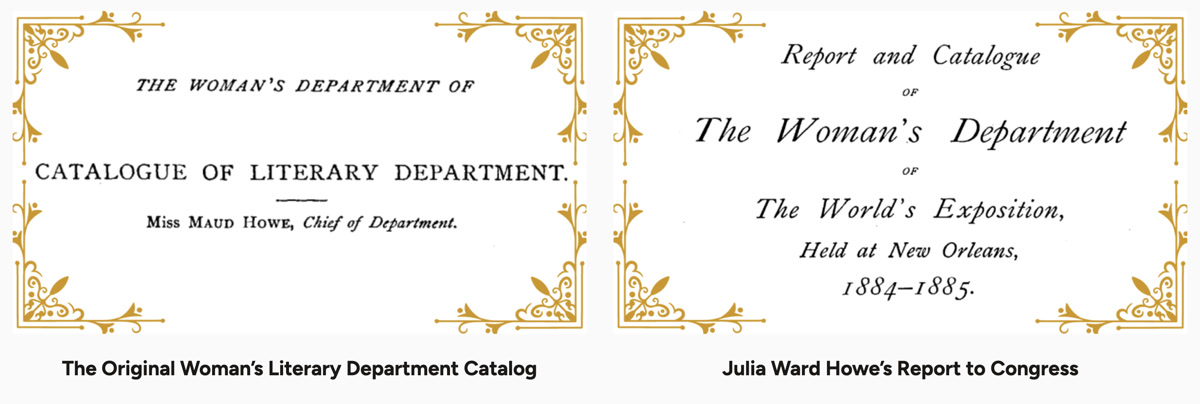
As co-directors of the Beautiful Sisterhood project, we are grateful for Julia’s Report and Maud’s shelf list. Their documentation enables us to recover a collection that holds significance for scholars of women’s literature and women’s history, world’s fairs and expositions, and southern and New Orleans history. But recovery is complicated.
Like “record,” “document,” and “archive,” the term “recovery” denotes a process that, too often, is understood only via its products—static, unified, empirical objects rescued from the past—which suppresses the acts of selection, mediation, and interpretation and the modes of social and institutional power that shape their meaning. To prioritize what we call “recovery without reification,” our team has found it essential to ask ourselves repeatedly what we mean by “Woman,” “Literature,” “the South,” and even “History” (a category that frequently grounds its authority in conceptions of fixed archival evidence) and to ask, further, how these concepts were used to stabilize and delimit each other in 1884. Julia Ward Howe’s Report, for example, resides at the Library of Congress as part of the official record because when the exposition directors ran out of funds, she successfully petitioned federal legislators for her own appropriation and was required to account for how she had spent it. What other exhibits, with less powerfully connected directors, went undocumented? And how can our recovery of the Woman’s Department avoid erasing those exhibits and directors all over again?
Consider Maud’s shelf list. Elegantly simple and clearly organized, it is an archival object that feels complete in itself and projects that same quality onto the literary archive it represents. But there was nothing elegant or simple about the library’s curation. Working in haste from a desk within the partially constructed Woman’s Department, Maud persuaded state delegates to relinquish written materials to her care. A writer herself, she also begged donations from publishing contacts in Boston and New York. The resulting collection was far from complete and heavily favored writers from northeastern states. Still, at the fair’s conclusion, Maud re-emphasized a conceit of organic unity when she expressed her unwillingness to break up the “beautiful sisterhood of books.” Instead, she declared, she would donate the collection intact to the Southern Arts Union, an organization boasting the city’s only free (whites-only) circulating library. And yet, many New Orleans women had resisted working under the leadership of either Howe—Maud, the New Yorker, or Julia, the famous Bostonian abolitionist and suffragist. Moreover, the sisterhood was ultimately disbanded: The Southern Arts Union went bankrupt just months after the donation, and the books—each with Maud’s bookplate affixed inside its cover—were dispersed and lost. Whose history and whose intention do we risk reifying, then, if we take Maud’s admirably thorough documentation (and charming characterization) for our blueprint? Recovery for whom? And from what?
The 1884 New Orleans Exposition was the first world’s fair to formally invite, fund, and house an exhibit devoted exclusively to women.2 This may seem surprising, given the South’s social conservativism. Indeed, location may help explain why scholars have largely disregarded the 1884 Woman’s Department and library.3 But it seems clear that New Orleans organizers chose to include women precisely because the region had a reputation for regressive social politics. Opening just seven years after the end of Reconstruction, the 1884 fair was overtly dedicated to fostering political and economic unity between the North and South. Performances of sectional friendship were staged throughout the fair’s run. Union and Confederate regiments met to return each other’s captured flags. Philadelphia sent the Liberty Bell by train to New Orleans, where it was ceremoniously welcomed by former CSA president, Jefferson Davis. By hosting the first world’s fair Woman’s Department and Colored Department, exposition leaders Edward Austin Burke and Colonel Franklin C. Morehead signaled the kind of modern social progressivism that might play well with northern and European investors. A reformed New South was open for business.
Feminist historians note that white women have frequently been called upon to represent political and economic principles on which they had little say, and this tradition was certainly in evidence at international expositions. In New Orleans there were the female symbols of “Agriculture, Trade, Navigation, and Mining” (many of them men in drag) waving at crowds from Exposition-themed floats during the 1885 Mardi Gras.4 But, of course, women—or womanhood—also represented regional interests. “The Centennial Poem,” written for the fair’s opening ceremony by Louisiana poet laureate Mary Ashley Townsend, greeted the international gathering in the persona of “fair-faced Louisiana, lo! / Mere fraction of her regal self—but oh. / A splendid fraction still!”5 Here is the white southern belle, her fragility and steely resolve communicating, at once, the warm hospitality and persisting resentments of her section.
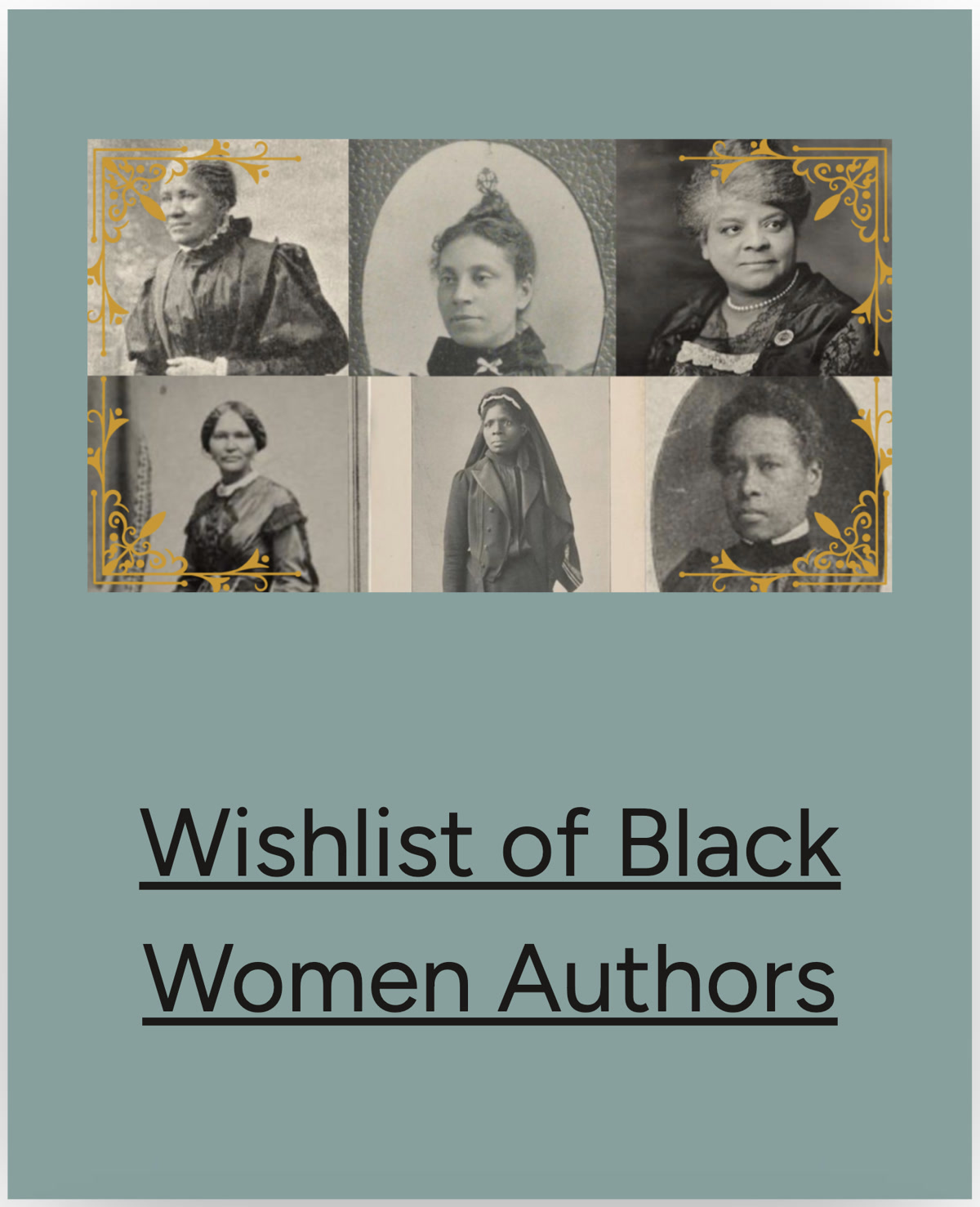
Under different circumstances, the New Orleans Woman’s Department might have adopted a similar persona. But numerous factors assured that its curation was chaotic and disunified, and its meaning(s) open to ongoing dispute. When Burke and Morehead appointed northerner Julia Ward Howe as department president, upper-class New Orleans women—already collecting items and arranging leadership among themselves—immediately protested. The secretary to the Board of Management, Richard Nixon, only fanned the flames by responding in the Picayune that “no Southern women possessed the national reputation and executive ability, nor the wealth, time, and physical capacity that Howe did.”6 By “national reputation” Nixon probably meant Howe’s fame as a suffragist and author of the abolitionist “Battle Hymn of the Republic.” More important, she had already overseen an exhibition of women’s work at the Boston Mechanics’ Institute Fair of 1883, which she organized around what Miki Pfeffer describes as “three special areas of women’s aptitude: inventions, literary offerings, and scientific work.”7 After Morehead toured the Boston fair, he and Burke invited Howe to apply the same approach in New Orleans. Their strategy paid off to some extent: Items that female M.I.T. students had shown in Boston came south with Howe to form the nucleus of another “Scientific Exhibit,” and Howe strove to showcase women’s “industrial” accomplishments – among which she included literary production. But before her department was even completed, Louisiana’s women opened their own exhibit downstairs in conjunction with their state’s men, congratulated by Louisiana Supreme Court Judge Felix Poche who declared them “essentially modest in character” and free of the “parasitic ambitions of certain strong-minded women.”8 On the 1884 New Orleans fairgrounds “woman” became a site of contending meanings, destabilized by multiple competing frameworks including the Old and New; North and South; Region, Nation, and World. Visit the “Wishlist of Black Women Authors” on the Beautiful Sisterhood project to learn more about how you can integrate this recovery work into your classrooms.
To foreground this instability, the Beautiful Sisterhood project focuses on three features of the department’s original design and presentation that, we argue, served—intentionally or not—to contain and impose coherence on its production of “womanhood.” In our full essay in Record, Document, Archive: Constructing the South Out of Region (LSU Press, Fall 2026), we explain more about how we approach (1) the Literary Exhibition’s framing as spectacle/setting rather than resource, (2) the totalizing rhetorics that masked its omissions and fractures, and (3) its implicit whiteness. By presenting these design features for query and analysis, the Beautiful Sisterhood project seeks to expose and counteract their effects. We provide access to a neglected archive while encouraging visitors to recognize the power dynamics that shape and destabilize the processes creating and representing archives—in 1884 and today.
2This Beautiful Sisterhood of Books
More than 130 years after the 1884 World’s Fair, the Beautiful Sisterhood collection has reemerged through digital archival processes using Maud’s shelf list. This historical primary source reflects how the Woman’s Department first developed and perceived the collection. The work of collecting, organizing, describing, and presenting historical documents with digital tools seeks not only to provide access, but also to create new methods for assembling and engaging with archival materials. This collection now exists beyond the static form that Howe depicted in 1884, and with that change comes new opportunities for challenging the reification of categories like “Woman,” “White,” “Literature,” and “the South.” To meet this goal, our team has devised a fully collaborative methodology across multiple disciplines and expanding the process of knowledge production by an interdisciplinary community.
3Digital Archives and Reification
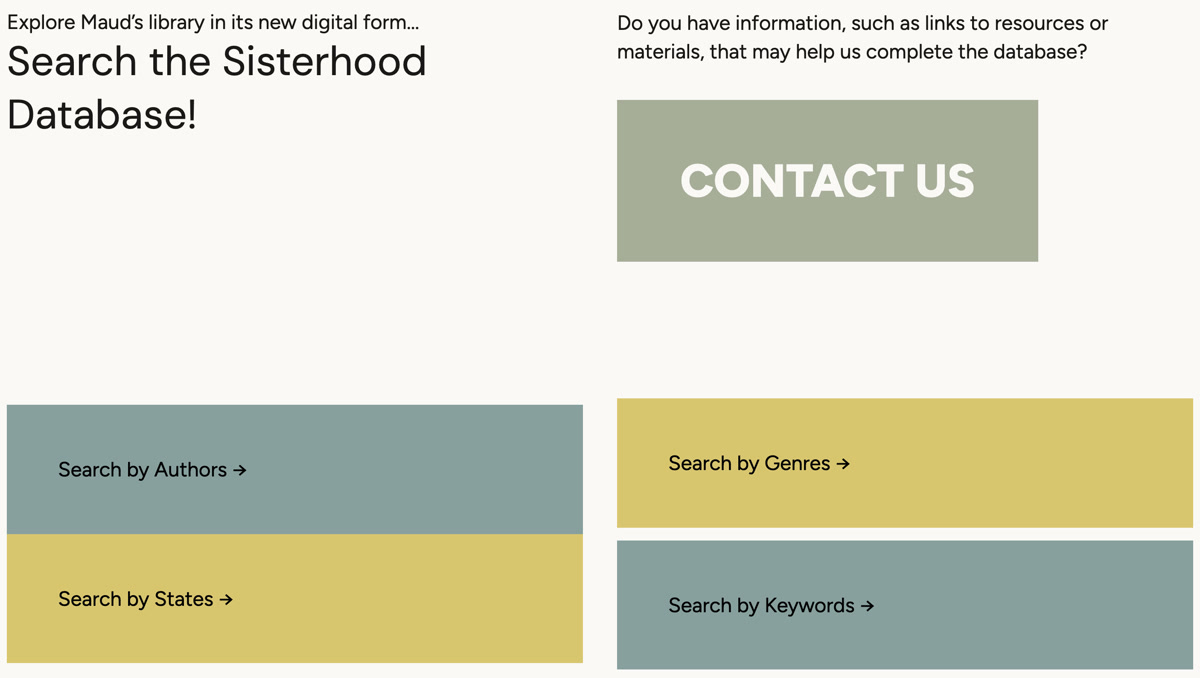
The Beautiful Sisterhood project primarily functions as a digital archive that reconstructs the physical collection Maud Howe hoped, but failed, to keep intact. The site’s database began with the books, newspapers, and sheet music curated by Howe for the 1884 World’s Fair. While librarians and archivists had already digitally preserved many of these materials in collections scattered across the internet, scholars and technologists on our team began by creating a spreadsheet that was transformed into a digital database.9 Read our essay in Record, Document, Archive to learn more about how we built the database and how visitors can access the primary source material.
When moving physical collections of historical sources into digital spaces, we risk replacing original perspectives with new, technologically curated perspectives. For example, the database allows the public to access individual works from the World’s Fair women’s library, despite the fact that these books and materials were untouchable for fairgoers in 1884. Conversely, we wanted to avoid reproducing the impression that the collection represents all women writers of the nineteenth century—especially since only a select group of white women authors were on exhibit in 1884. Digital tools allow us to preserve and alter perspectives on historical materials, and digital humanities scholars must use them mindfully to engage twenty-first-century audiences.10
To date, our most ambitious renovation to the original exhibit addresses its omission of Black women writers. To confront Julia Ward Howe’s failure to integrate the collection, we launched a second phase of the project focused on recovering the presence and absence of Black women. This began with students in Adams’s Spring 2023 graduate seminar at Tulane University, who generated a list of writers, events, issues, and concerns they wished to incorporate. However, the class and technical team also agreed that simply adding Black women’s publications into the database was unsatisfactory. We wished neither to erase the historical fact of the 1884 collection’s Jim Crow instantiation, nor to downplay the racism of the white women organizers and exhibitors. Here, again, it seemed crucial to preserve, in some form, the perspectives of original fairgoers in the post–Reconstruction South. We decided to build an interactive digital humanities exhibit, titled Black Women and the 1884 World’s Fair, that would link to the database but also stand on its own as what Kim Gallon terms an “alternative construction.”11 Visit “Teach the Sisterhood” on the Beautiful Sisterhood project to learn more about how you can integrate this recovery work into your classrooms.
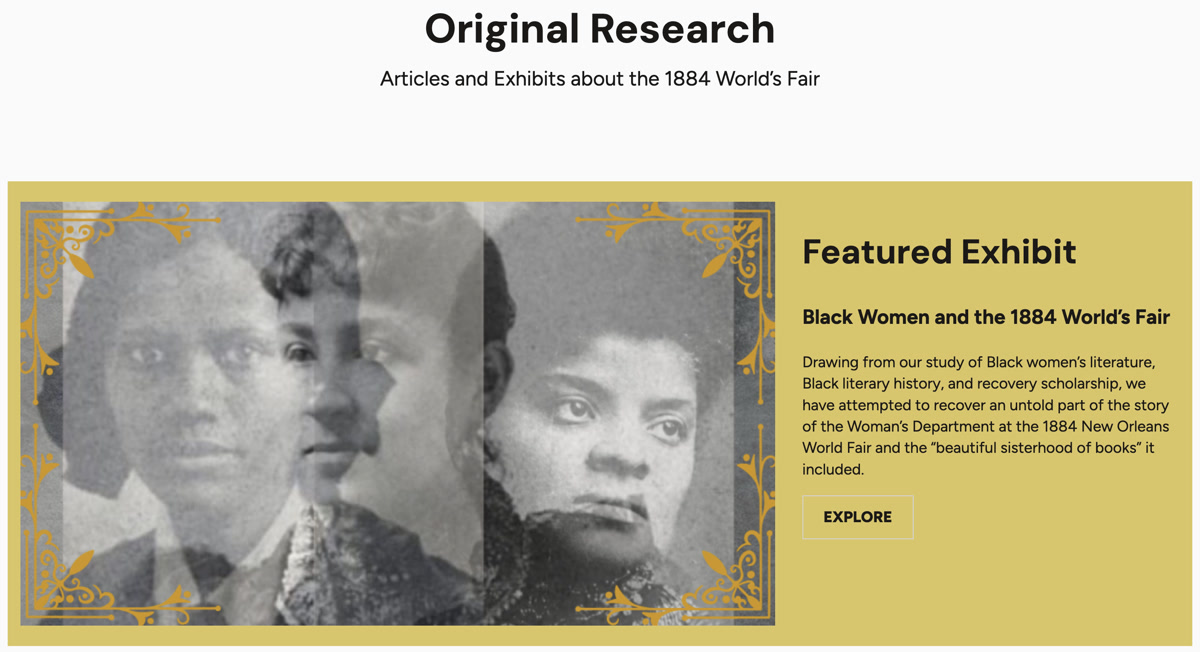
The resulting digital exhibit built through classroom and internship integrations features essays, timelines, and maps about Black women who wrote and published materials before and shortly after the 1884 World’s Fair. The exhibit’s “Wish You Were Here List” features the names of Black women writers on whom students have already conducted research and asks viewers to suggest additional authors and works, and to submit their own research for inclusion. Currently, we are working on making our wish list as “findable” as possible, to attract new collaborators and create new pathways for learning about nineteenth-century Black women authors and the fair. We will integrate every literary title, author, and keyword featured in the Black Women Writers exhibit into the site’s original database. Each Black author will have a searchable author page, like their white counterparts, and each literary work will have a searchable book page and a recovery icon that helps viewers recognize that they were not always included. We especially want to illustrate the range of works produced by Black women writers during this period but to do so without erasing the anti-Black conditions in which they lived and worked.12
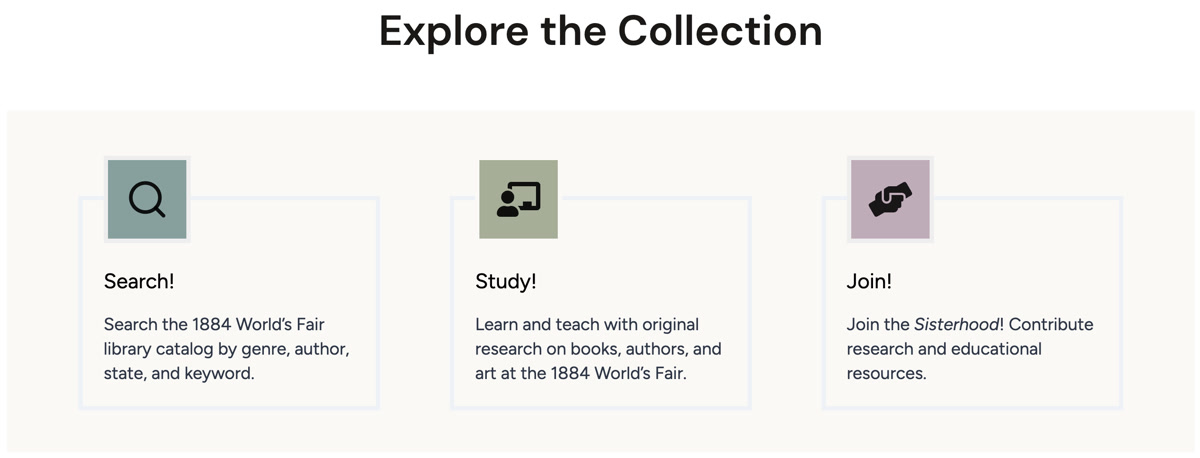
To enhance this experience, we have designed the site to encourage users to interact with its form and function through multimodal pathways that allow visitors to choose roles such as learner, expert, and advocate. The site immediately prompts visitors to explore the collection through the project’s central modes of “search,” “teach,” and “join.” From the menu, users may choose how they engage with the site by exploring the digital archive and exhibits and making research and technical contributions through classroom integrations and crowd-sourcing. We invite you to visit the “Join the Sisterhood” page to learn more about how to use the site and contribute original research and crowd-sourced knowledge.
4Digital Archives and Collaboration
Digital humanities projects often involve a group of people from various backgrounds working together to make usable digital artifacts, but those roles are usually divided and compartmentalized due to time and expertise constraints. Our team represents the humanities, social sciences, and STEM and data sciences. We, however, do not silo expertise so that humanists work on research and scientists work on technology. Thus, we make space for everyone to learn from and support each other, sharing responsibility for understanding how technical components present the material. As an editorial team, we responded to the opportunities and limitations of expertise by developing a digital humanities methodology around collaboration and “cooperative learning” informed by feminist scholars.13
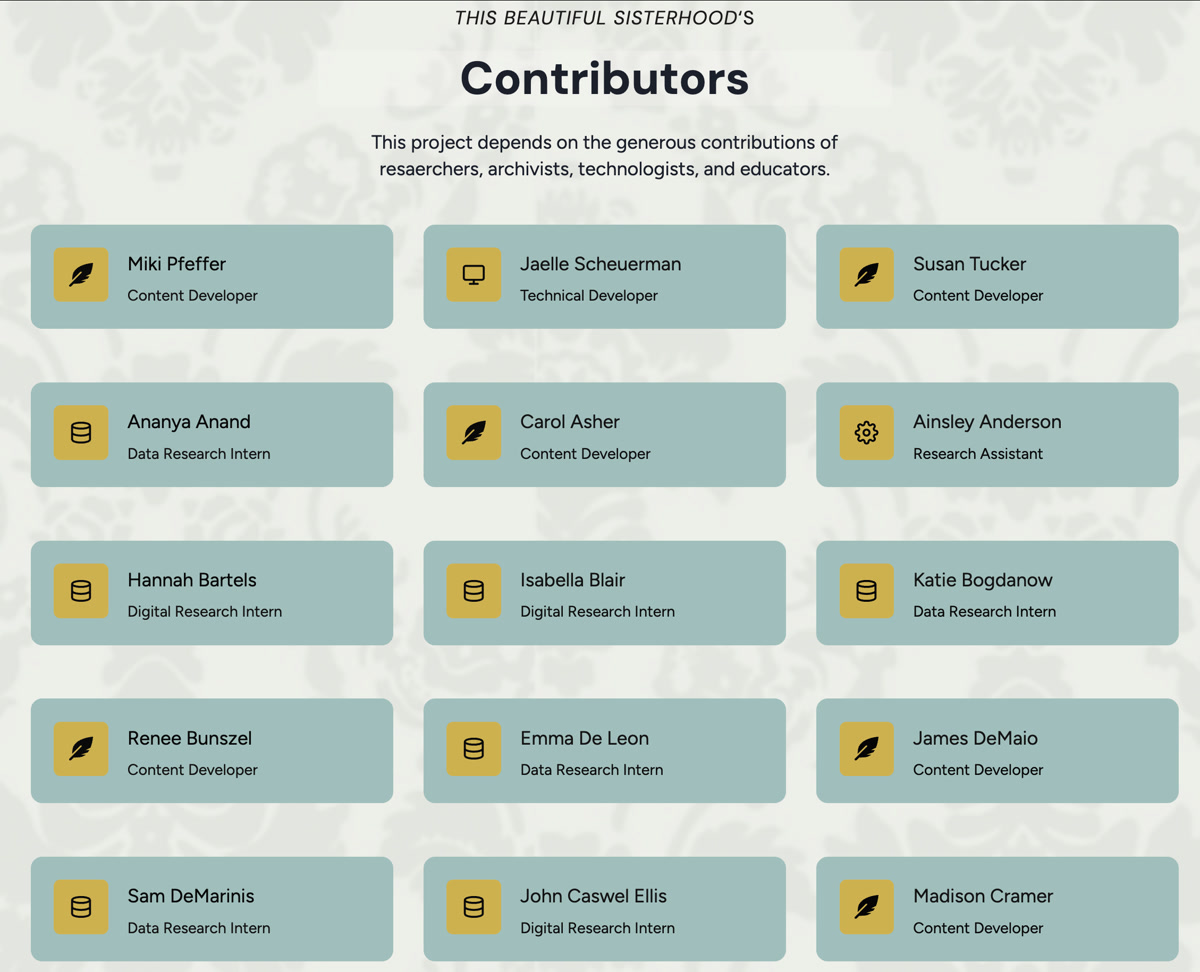
Digital humanities projects such as the Beautiful Sisterhood project require a tremendous amount of time, labor, and expertise when recording, documenting, and archiving historical materials in digital mediums. This project exemplifies collaborative recovery work because of the amount of the “invisible labor” required from many people of varying disciplines and skills to produce a historically based technical project.14 To spotlight faculty and students’ numerous contributions to the building and maintaining of the project, we have incorporated an educational mission as a main priority. The Beautiful Sisterhood project teaches students how to record, document, and archive works digitally as a way to honor the process of doing digital humanities work, instead of aiming for a specific result as a mode of “production.”15 By teaching process-based recovery work to students and, in exchange, learning from them, we have advanced the core function of the project’s purpose as an educational tool.
The original collection put together by the Woman’s Department and presented at the World’s Fair represented an incomplete assemblage of sources due to the racialized and gendered social mores of the post–Reconstruction U.S. South that manifested on this global stage. Through our digital archival processes, we carefully considered technology platforms and design features as prime movers of content creation. We have continually embraced change and expansion while working on the project by blending our design and development processes with our user experience throughout each new phase. With new phases of the project, we constantly evaluate how to interconnect new features—such as interactive exhibits, additional primary sources about the fair, and scholarly articles—into existing elements on the site (e.g., the database). We have chosen to keep this digital archival collection and digital humanities site in a consistent state of development to maintain a productive tension that allows for embracing and maintaining design momentum, an educational mission focused on process, and mutually supportive collaborations.
Notes
- Weimann, The Fair Women, 391.
- Ironically, the promised funding never materialized, and the exhibit site was only partly constructed when Howe’s team arrived in New Orleans. See Pfeffer, Southern Ladies and Suffragists, chapter 7.
- Weimann’s book about the Chicago Woman’s Building begins with a lengthy preface about women’s contributions to the 1876 Philadelphia World’s Fair, simply eliding the 1884 Exposition. Similarly, New Orleans is mentioned only in passing in Boisseau and Markwyn. The work of recovering the history of the 1884 Woman’s Department did not begin in earnest until 2014, with Pfeffer.
- Pfeffer, Southern Ladies and Suffragists, 116.
- Townsend, “The Centennial Poem,” 24.
- Pfeffer, Southern Ladies and Suffragists, 18.
- Pfeffer, Southern Ladies and Suffragists, 17, 23.
- Pfeffer, Southern Ladies and Suffragists, 117.
- Ramsay and Rockwell, “Developing Things,” 75–84.
- In our essay in Record, Document, Archive, we contend with Donna Haraway’s theory of the “God Trick” and other problems around reification when building and accessing the database.
- Gallon, “Making a Case for the Black Digital Humanities,” 44.
- In our full essay, we describe how we built the exhibit and recovery icon using inclusive digital humanities theories.
- See “Tenets.” For more, see Losh and Wernimont, Bodies of Information. See our essay in Record, Document, Archive for more on our feminist collaboration model.
- D’Ignazio and Klein, Data Feminism, 178–85.
- D’Ignazio and Klein, Data Feminism, 184–92.
Bibliography
- Boisseau, T. J., and Abigail Markwyn, eds. Gendering the Fair: Histories of Women and Gender at World’s Fairs. University of Illinois Press, 2010.
- D’Ignazio, Catherine, and Lauren Klein. Data Feminism. MIT Press, 2020.
- Gallon, Kim. “Making a Case for the Black Digital Humanities.” In Debates in the Digital Humanities, edited by Matthew K. Gold and Lauren F. Klein. University of Minnesota Press, 2012.
- Haraway, Donna. “Situated Knowledges: The Science Question in Feminism and the Privilege of the Partial Perspective.” Feminist Studies 14, no. 3 (1988): 581–82.
- Howe, Julia Ward. Report and Catalogue of the Woman’s Department of the World’s Exposition, Held at New Orleans, 1884–1885. Rand, Avery, and Company, 1885.
- Losh, Elizabeth, and Jacqueline Wernimont, eds. Bodies of Information: Intersectional Feminism and the Digital Humanities. University of Minnesota Press, 2019.
- Pfeffer, Miki. Southern Ladies and Suffragists: Julia Ward Howe and Women’s Rights at the 1884 New Orleans World’s Fair. University Press of Mississippi, 2014.
- Ramsay, Stephen, and Geoffrey Rockwell. “Developing Things: Notes Toward an Epistemology of Building in the Digital Humanities.” In Debates in the Digital Humanities, edited by Matthew K. Gold. University of Minnesota Press, 2012.
- “Tenets.” In Feminist Pedagogy for Teaching Online, edited by Jacquelyne Thoni Howard, Enilda Romero-Hall, Clare Daniel, Niya Bond, and Liv Newman.
- Townsend, Mary Ashley. “The Centennial Poem.” Reprinted in The World’s Industrial and Cotton Centennial Exposition New Orleans, 1884–1885, by Herbert S. Fairall. Republican Publishing Company, 1885.
- Weimann, Jeanne Madeline. The Fair Women. Academy Press, 1981.