

1Introduction
On Sunday afternoons in 1939, eleven-year-old Ferdie Walker would walk a few blocks from her house in Fort Worth, Texas, and wait for the bus that would take her to a weekly youth function at her local United Methodist church, but she did so with much uncertainty and fear, as two white policemen “would harass me as I was standing on this corner waiting for the bus to come. Sometimes the two of them would drive up. The bus stop was up high and the street was down low. They’d drive up under there and then they’d expose themselves while I was standing there, and it just really scared me to death.” As a result, “I had a morbid fear of policemen all of my life and it has not completely gone away. This was in the broad open daylight with the sun shining. But I will never forget it.” In reflecting on her own past, she also associated it with the danger that others faced from unwanted white male attention: “That was really bad, and it was bad for all black girls, you know.” So instead of protecting and serving the African American community, these white officers sexually harassed a little girl in public, putting her in fear of law enforcement officers for her entire life, as she and other Black women and children knew that rape might result from this kind of unsought encounter.1
Walker’s moving story appears in Remembering Jim Crow: African Americans Tell About Life in the Segregated South. Again and again in this oral history, the police appear as harassers, abusers, and even murderers but never as defenders of Black rights.2 As white agents of the city, the county, and even the state, the police were the front-line enforcers of white supremacy in general and the Jim Crow criminal injustice system in particular. They were the visible, threatening group that let all African Americans know that their safety, their freedom, or even their lives could be forfeited for any infraction, real or imagined, of white-made law.3
These harsh realities were well documented in their own era by poor and working-class people through the blues. As the poet and activist Sterling Brown observed, this essential American roots music contained “a bitter honesty” and could often generate “full looks at social reality,” as well as “treat the violence that is real and rampant in the lives of these people.”4 Unfortunately, one of the most present agents of real-life brutality and bloodshed in the Black community was the police, and as Brown suggests, the blues did not shy away from addressing this issue. The blues, born in a racialized South gripped by ever-increasing segregation, jumped up on the stage and stepped up to the microphone—shouting out against many of the wrongs of the Jim Crow era, including a condemnation of police behavior that adversely affected the Black community.
Voiced by poor and working-class African Americans, blues of this period document police prejudices, abuses, and violence directed at Black America in both rural and urban spaces in the aftermath of slavery and Reconstruction. The police in these configurations could represent an array of positions—night watchmen, constables, city police, marshals, sheriffs, and others. In essence, any number of white officials considered “police” could exert power over Black citizens in the South during this period. An examination of the history of policing of this era in conjunction with an exploration of several songs, their stories, and some key images found in them reveals this group’s collective and unflinching perception of the police as agents of racial violence and oppression. They also expose the underlying unjust legal structures of social discipline inherent in the attitude and actions of this primarily whites-only force. In responding to the inequities of white-dominated policing in the era of Jim Crow, a few blues songs also offered up images of violence in response, suggesting a communal desire to physically resist the abuses perpetrated by the police. Together, these songs and the sentiments in them manage to reflect and reject the legal and social constructions of race during this period and, at the same time, to expose the distinction between the idea of equal justice under the law and the reality of a racialized legal system and its accompanying enforcement.
2Policing Blackness
Even before the rise of Jim Crow, the specific forces that policed Black behavior had an adversarial and abusive relationship with this selfsame community. During slavery, sanctioned groups of white slave patrols roamed the night in both rural and urban areas, monitoring the actions and movements of slaves. These patrols checked passes, captured runaways, meted out punishments, and generally enforced a rigid racial hierarchy. Their pervasive oppressiveness inspired the folksong “Run, N[-----], Run,” with its threat that “the patterrolller catch you” and its admonition to flee their very presence.5 In reflecting on the nature of these “patterrollers” or “paddyrollers,” one former slave, W. L. Bost of North Carolina, stated, “They jes’ like policemen, only worser.”6 Here, he links the slave patrols and the police, just as African American sociologist and activist W. E. B. Du Bois does in his classic collection of essays, The Souls of Black Folk (1903): “The police system of the South was primarily designed to control slaves,” adding that even after the Civil War, the South’s “police system was arranged to deal with blacks alone.” Du Bois goes on to reflect on both the pre– and post–Civil War reality of southern policing: “The police system of the South was originally designed to keep track of Negroes, not simply criminals.”7
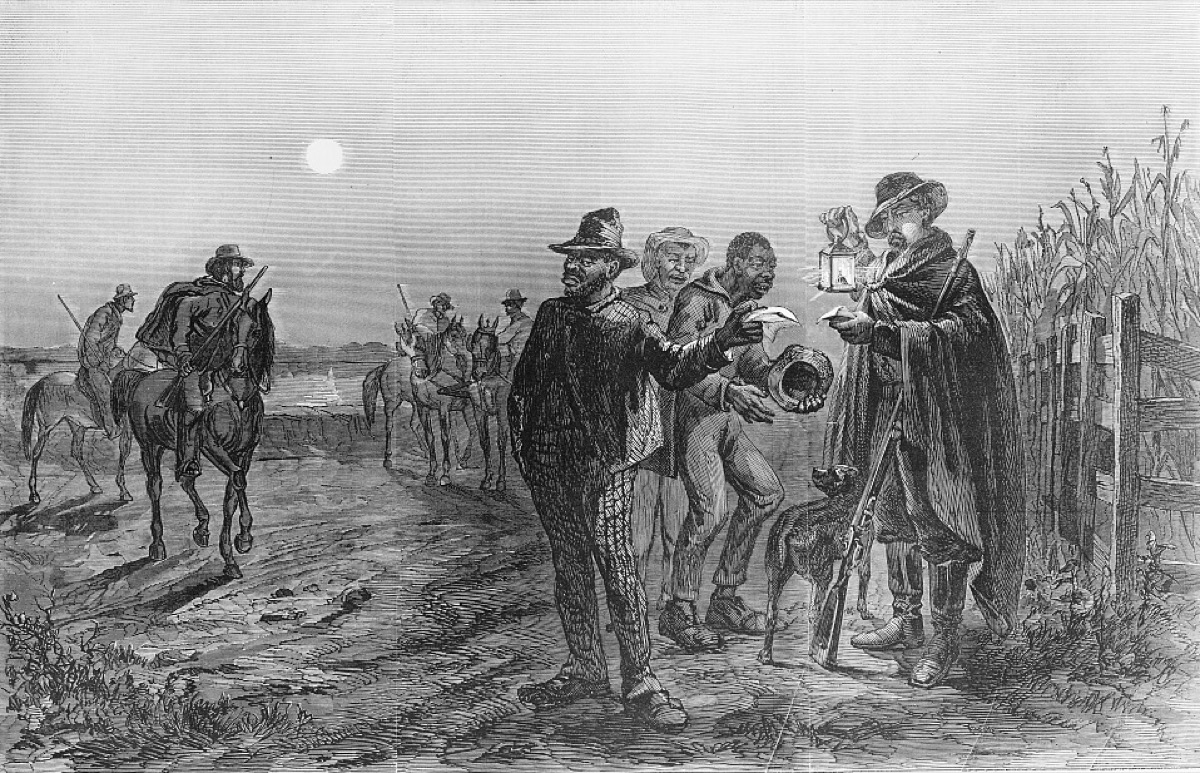
Contemporary historians also concur with these earlier claims by Bost and Du Bois. For example, Sally Hadden, author of Slave Patrols: Law and Violence in Virginia and the Carolinas, argues that there is a direct line between the techniques and attitudes of Jim Crow police and those used by slave patrols: “Postwar police forces would transform patrolling into a highly effective but still legal means of racial oppression, building upon the practices that many prewar police forces had used. [. . .] Through at least the first half of the twentieth century, policemen had great latitude to confine, question, brutalize, and release suspects without recourse to more formal judicial settings, just as slave patrollers had done on their nightly rounds for the sake of racial control.”8 In effect, the first policing of Blacks by community- and legally sanctioned groups set the standard during and well after the slavery era, establishing them as racial oppressors, not as agents of protection or justice.
After the Civil War, extralegal patrols that focused on Blacks appeared in the South through the efforts of the newly formed Ku Klux Klan and other vigilante groups, but now they were joined in their efforts to control Black behavior and movement by official police forces in both rural and urban spaces. As a result, this duly authorized group became a de facto agent of segregation and disenfranchisement throughout the South for generations, with enforcement based on racial disparities. During the Reconstruction period, some Black police officers did serve on the forces of a few southern metropolitan areas, such as in New Orleans, Charleston, Atlanta, and Houston, but even their limited presence was relatively short-lived, for after the withdrawal of federal forces in the mid-1870s, white southern voters and politicians began purging Black officers from their ranks. As historian W. Marvin Dulaney reveals, “By 1910, African Americans had literally disappeared from southern police forces.”9 As a result of this oppressive past, even with its brief and limited respite during Reconstruction, by the arrival of the twentieth century, as Leon Litwack notes, “In communities across the South, blacks came to perceive the law and its enforcers as an outside and alien force, an intrusive and repressive agency against which appeals for fairness and impartiality, humane and just treatment, were all but useless.”10
Part of this configuration that Litwack indicates stemmed out of how Blackness became defined in law and practice—both the era of slavery and after. As Colin Dayan has posited, throughout our nation’s history, “legal thought relied on a set of fictions that rendered the meaning of persons shifting and tentative: whether in creating slaves as persons in law and criminals as dead in law.”11 In either case, these groups became limited in terms of their legal status, rights, and power; and when this process occurs, “they are then judged outside the law’s protection or most susceptible to its violence.”12 Bryan Wagner, in Disturbing the Peace: Black Culture and the Police Power After Slavery, goes even further when he argues that “the idea of blackness was . . . constructed to justify slavery” and that the law saw “the slave, first and foremost, as a potential threat.”13 As a result of these past legal constructions and prejudices, “seen from the standpoint of the police power, blackness is imperceptible except for the presumed danger it poses to public welfare.”14 So in the aftermath of slavery, the controlling and punishing group of this white-perceived threatening Blackness transferred from the master, the overseer, and the slave patrol to a duly imposed police force that sought to confront the entire Black community as being dangerous, an idea reinforced though a variety of means in the law and through popular media.15 Also, beginning in the late nineteenth century, many social scientists, journalists, politicians, and others began using racialized statistics to further present the idea of Black criminality to the public, setting up what Khalil Gibran Huhammad calls “one of the most widely accepted bases for justifying prejudicial thinking, discriminatory treatment, and/or acceptance of racial violence as an instrument of public safety.”16 So, even after the abolition of slavery, this white-controlled construction of Blackness offered up a dangerous and threatening image, an unfortunate but intended move that helped create the problematic and confrontational relationship between African Americans and the white police forces in the South during Jim Crow.
3The Blues Responds
Around the same time as Blackness was being linked to criminality and danger, and when the shining promise of the abolition of slavery was morphing into the dark reality of a fully segregationist South, the blues came into being. Unlike their sister spirituals, this Black-centered music largely turned from the supernatural possibility of a welcoming and egalitarian afterlife and instead looked at the too-often grim truth of this world. It makes for a kind of documentary art form, one that drew upon the experiences of poor and working-class southern Blacks and commented upon them, whether as autobiography, communal biography, or even as a fictional reflection of actual Black experience and beliefs. Out of many topics taken up by this often reality-based musical expression, the police loom rather large as the subject for discussion. On rare occasions, they do find positive representation, but for the most part, they are denounced and defamed, their mere presence in blues song suggesting that harassment, arrest, abuse, or even death may come to those unlucky enough to engage with any officer of the law.
Through many means, the blues offers up powerful counternarratives to the larger presentation of the Black community by those outside of it and to the presentation of the police as a just regulatory force. As Fred Moten and Stefano Harney note, “The black radical tradition,” of which the blues is certainly a part, draws upon “a fundamental element of that terror-driven, anesthetic disavowal of ‘our terribleness.’”17 Many of the blues presented here offer narratives wherein innocent Black citizens are harassed, abused, and arrested by the police. Thus, the African American community appears as the transgressed and the police as the transgressors, a rebuke to the storylines of Black criminality and impartial justice.
Another reason that the police find themselves the topic of blues songs stems out of this group’s role as the initial gatekeepers into the larger Jim Crow criminal injustice structure, which almost completely excluded African Americans except as the accused in that judges, juries, lawyers, clerks—the whole human apparatus of the courts—would have usually been white, along with the legislators who wrote the laws that these institutions were enforcing. Obviously, any displeasure with this larger entity would also be set in evidence in any reference to the police as they first placed Blacks within the confines of this white-controlled legal space. As historian Edward Ayers notes, “Blacks felt themselves persecuted by the entire machinery of government, and the police stood as the most visible and galling element that state.”18 When we look into the blues as a reflection of real-world troubles and woes, we also see this dissatisfaction boldly manifested—both explicitly with the system of policing and implicitly with the racialized system it represented.
4The Image and Meaning of Standing on the Corner
Although there are many blues songs—drawn both from the folk tradition and the popular culture realm—wherein the police make an appearance, one specific repeated image offers up an especially telling commentary on this organization and their perception by the Black community. The lines “Standing on the corner didn’t mean no harm. / Police came and grabbed me by my arm” (or some variant) appear in many blues from the end of the nineteenth century and up to the 1960s.19 This couplet sends a deeply troubling message. A citizen, doing nothing more than being in a public place without malice, is harried or even arrested by the police. Little Ferdie Walker was just standing on the corner, meaning no harm as she waited for her bus to take her to church—thus exposing her to repeated sexual harassment from the police. Hers is in individual tale, but her experience and those shared by others make for a collective experience, one expressed through several blues songs.
Part of the power of these lines and the songs in which they appear comes from their larger context. Because the singers in these examples are African American, the song’s narrators would also be understood as such, while southern police in this era would be presumed to be white. Thus, the only supposed guilt, the only unifying criminality indicated in these songs is the skin color of those taken up by authorities. Thus, this repeated scene points to the police as an unjust force, one engaged in racial profiling. For the narrators’ very bodies set them as dangerous, as criminal; the police harassment conjured through these lines contain a culturally projected image, one establishing any African American as suspect—as needing detainment or arrest, no matter their actions—due to their Blackness. Also, in that variations of this couplet appear again and again, it may be surmised that the singers, as a unified community, share this experience—making it communal. Furthermore, this representation circulates through public performance, whether presented directly to live audiences or disseminated through commercially recorded blues songs. Its repeated articulation suggests that Black listeners were receptive—or at least imagined to be receptive by the performers—to this portrayal of the police as enforcers of a racialized system that cast African Americans as inherently criminal and therefore subject to harassment and arrest.
As a result of this situation, a troubling narrative appears. For the corner, both literally and figuratively, becomes a dangerous place for African Americans. Standing on an actual corner, with traffic flowing from several directions, allows for an individual to be easily seen by many people, including the police. This conspicuousness would allow for harassment or arrest due to the criminal perception of Blackness by law enforcement. But in these lines, the corner also can become more—a representative of any exposed public place. For this particular site only appears at a crossroads, a symbolic space where the police become the devil. For if they see you, then it invites their scrutiny, and they can then act against you. Thus, this narrative of the corner implicitly warns Black listeners that simply being in public can result in police harassment or even arrest, even if you are doing no wrong. The fear of the police could potentially limit movement, public action, free speech, or other civil liberties if Black citizens doubt their safety when in public. As legal scholar Risa Goluboff argues, “Any right would be hard to vindicate if a person could not walk down the street without being arrested for who he or she was.”20 For in these lines and in the songs where they appear, the police become agents of anxiety, dread, and oppression—dangerous and violent representatives of the larger Jim Crow system meant to control and dominate Blackness throughout the South.
5Beginnings of These Lines
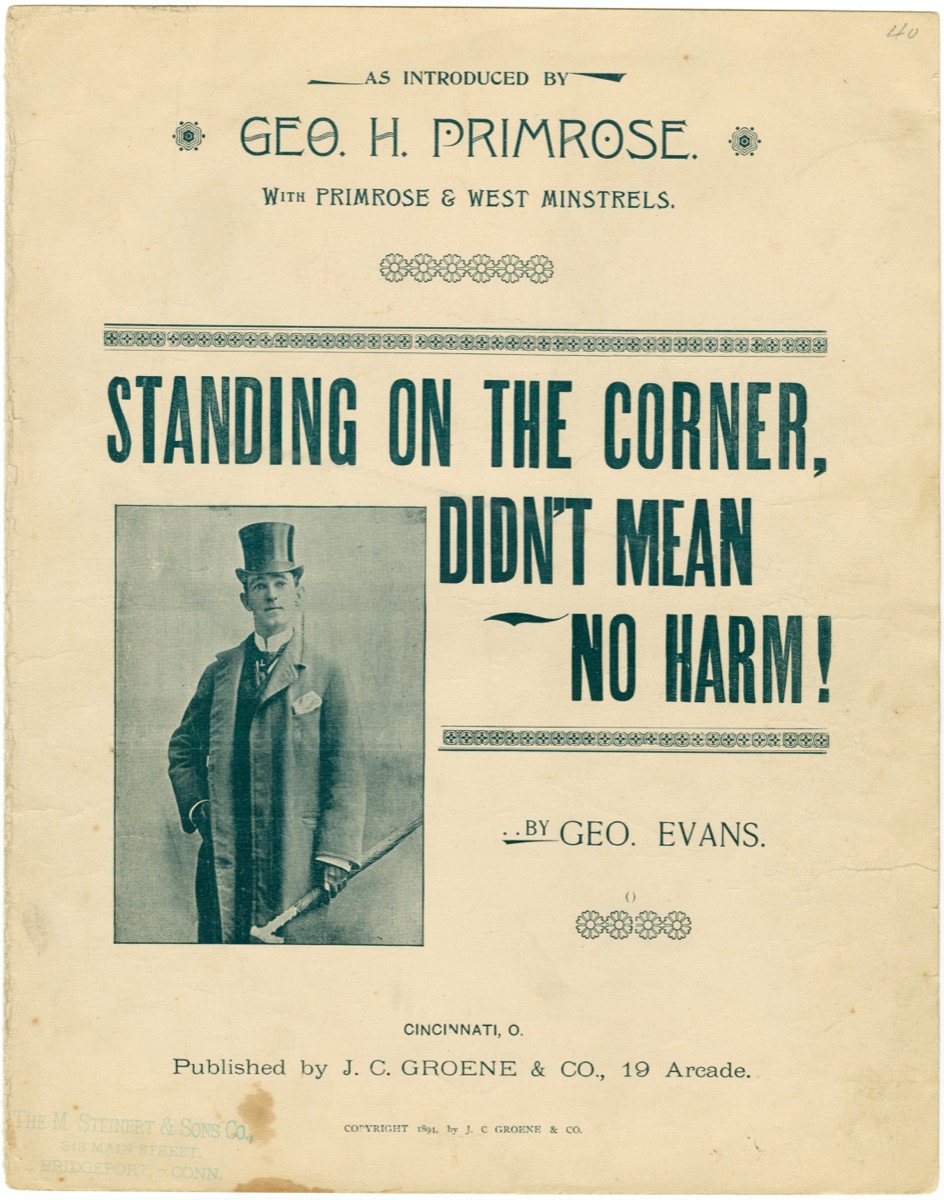
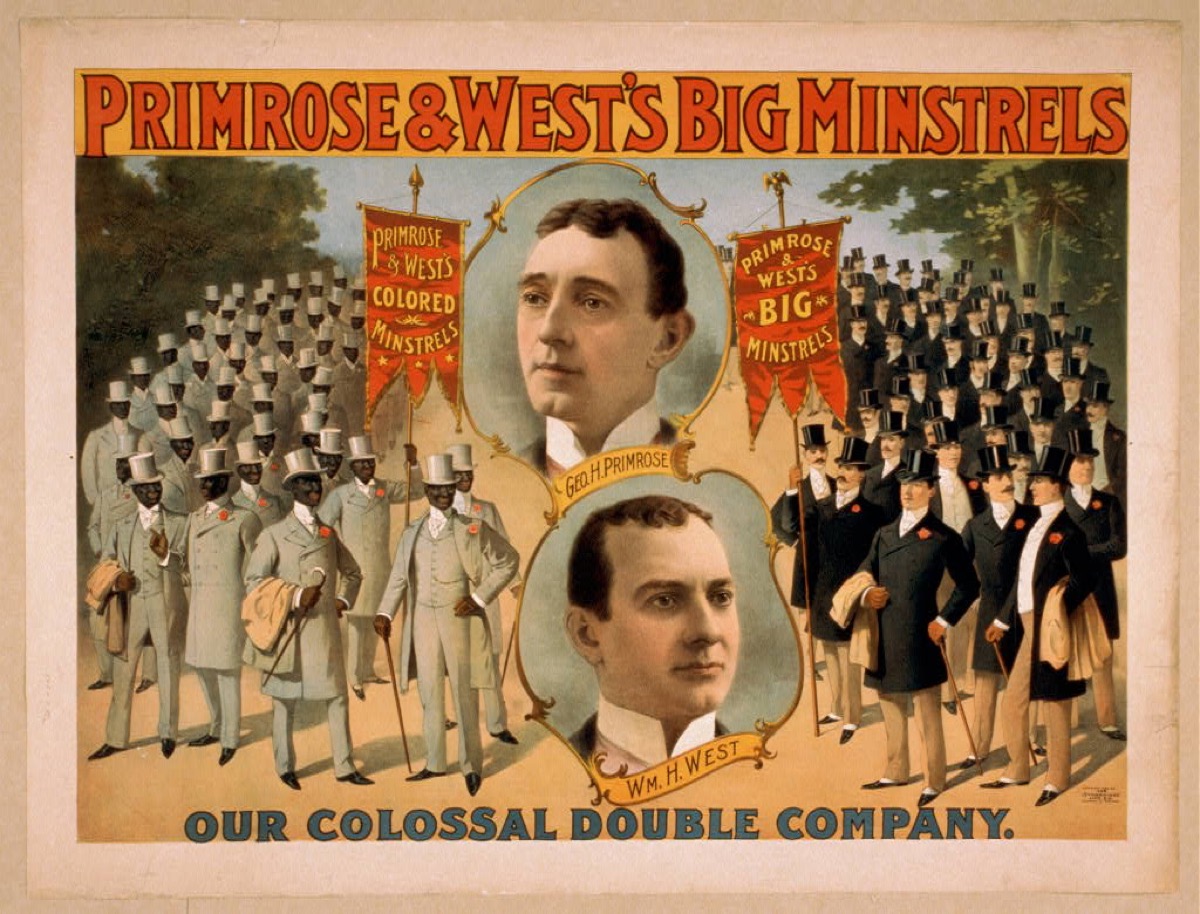
Although they appear in many blues songs, these lines were first published in piecemeal form by two white composers—men who were well-steeped in minstrel, ragtime, and Black folk traditions of their era. In 1893, Welsh-born George “Honey Boy” Evans published “Standing on the Corner, Didn’t Mean No Harm!” He was a member of several musical troupes where he often performed in blackface, including George M. Cohan’s company and with the Primrose and West Minstrels. Certainly, the song offers up typical racialized fare, with an unnamed narrator celebrating Susan Brown, “the swellest colored gal in this hyar town.” On an outing that ends up in the scene described in the title, an incident occurs. But rather than a police officer, “Up came a coon and her grabbed her by de arm.” The offending party finds that he is “running up against the real thing” when the narrator pulls out a razor to defend his love.21 This song became one of Evans’s signature pieces, along with “I’ll Be True to My Honey Boy,” from which he gained his nickname. Evans drew upon Black musical traditions in this and several of his other compositions, such as “Dis Coon Lubs Oo,” albeit in a degraded and degrading manner, which was typical of this time period. He may well have borrowed these lines as a well-established trope to give his own composition credence. However, it was another composer who added the second essential element that was soon to become a telling moment in Black folksong in general and blues in particular in how the police were depicted.
Building on Evans’s use of a familiar trope to lend authenticity to his song, it was Ben Harney who more explicitly crystallized the encounter between an innocent Black narrator and the police, adding a second element that would later become central to blues and Black folksong narratives. Harney composed “You’ve Been a Good Old Wagon but You’ve Done Broke Down” sometime in the late nineteenth century, when he was living in Middlesborough (now Middlesboro), Kentucky. It was a boomtown, one that drew a large Black population that mixed with local whites, allowing a young Harney to encounter and embrace musical and lyrical elements from Black folksong.22 These influences resulted in this song and others such as “Mister Johnson, Turn Me Loose” and “Cake Walk in the Sky,” all ragtime pieces. “You’ve Been a Good Old Wagon,” published in 1895, opens with the lines, “I was standing in a crapgame doing no harm, / When a Copper grabb’d me by my arm.” As the story goes on, the narrator reveals that he has been left by his love, who depicts him as the broke-down wagon she sets aside after he has been held over without bail for murder.23 Neither of Evans’s or Harney’s songs combine the elements of being out in public, with no intention of ill will towards the public, only to be taken up by the police, but both strongly suggest that these images—and the music on which they ride—came from African American sources.24 This particular couplet that we have been discussing perhaps originated as an amalgam of lines from Evans’s and Harney’s songs, a shifting of either one, or a pure folkloric creation from Black music merely copied in part by these white composers.
Whatever their exact source, these lines certainly resonated with many African American musicians. In particular, the full expression of this couplet first appears in print through the collecting efforts of folklorist Howard Odum. He discovered them through his fieldwork on Black folk song in Mississippi in 1905, and they are found in the lyrics of the blues ballad “It’s Lookin’ for Railroad Bill.” In the final stanza, which opens with the key lines, “Standin’ on the corner didn’t mean no harm, / Police grab me by my arm,” the narrator is not the actual target, for the encounter involves a case of mistaken identity, as the authorities in the song are searching for the outlaw of the title, suggesting that all African Americans look alike to the police.25 But this image and these words are found not just in songs gathered by folklorists throughout the first half of the twentieth century, for beginning in the 1920s, many African American blues singers also decided to include similar language in their recorded work for commercial labels.
Sometimes they come with little or no further commentary about the police, but in the vast majority of the instances where these lyrics appear, an officer not only takes up the narrators by their arms but also arrests and incarcerates them, even subjecting them to forced labor and violence at times. So, when we find these lines, with their implicit suggestion of Black innocence and explicit detail of white seizure, it makes for a collective condemnation. In these songs, those charged with enforcing the law frequently treated race itself as sufficient evidence of criminality, thereby offering a powerful indictment of institutionalized racism in policing. Although this expression may not be as blunt a denunciation of the police as found in some rap songs, such as NWA’s very explicit edict, “Fuck tha Police,” these blues lyrics contain their own particular imaginative and expressive language, yet they do not just project out these images; they also reflect a reality of the historical moment for the Black community, when racial oppression manifested in police harassment and brutality.
6The Dangers of the Corner
Some versions of these lyrics and the songs in which they appear offer no explicit reason for an encounter with the police. For example, “Ole Marse John,” which appeared in Dorothy Scarborough’s survey of African American folk songs, On the Trail of Negro Folk-Songs (1925), we find the lines, “Standin’ on de corner, wa’n’t doin’ no harm; / Up come a ‘liceman, grabbed me by de arm.” But after the officer “rang a little whistle, blew a little bell,” resulting in “de p’trol wagon” rolling up on the scene, the narrative breaks to a completely different location in the next stanza—a chicken house—making for a rather jarring transition and a disjointed storyline without a clear political point. But Scarborough, even through the lens of racial superiority with which she viewed African Americans, notes that “the Negro puts together nonsensical lines, but they usually have their own queer logic.” The underlying meaning of the song might be discerned through an examination of the chorus, which offers up some measure of a larger coherent point: It presents the lines, “Yes, mourner, you will be free, / When de good Lawd sets you free.”26 This idea also often appears in other songs, especially those with a mocking tone concerning race and religion.27 Here, though, they suggest a critical-comic response to the narrator’s arrest, i.e. true freedom, even decades after the end of slavery, remains more of a hope for heaven than a reality in the Jim Crow South.
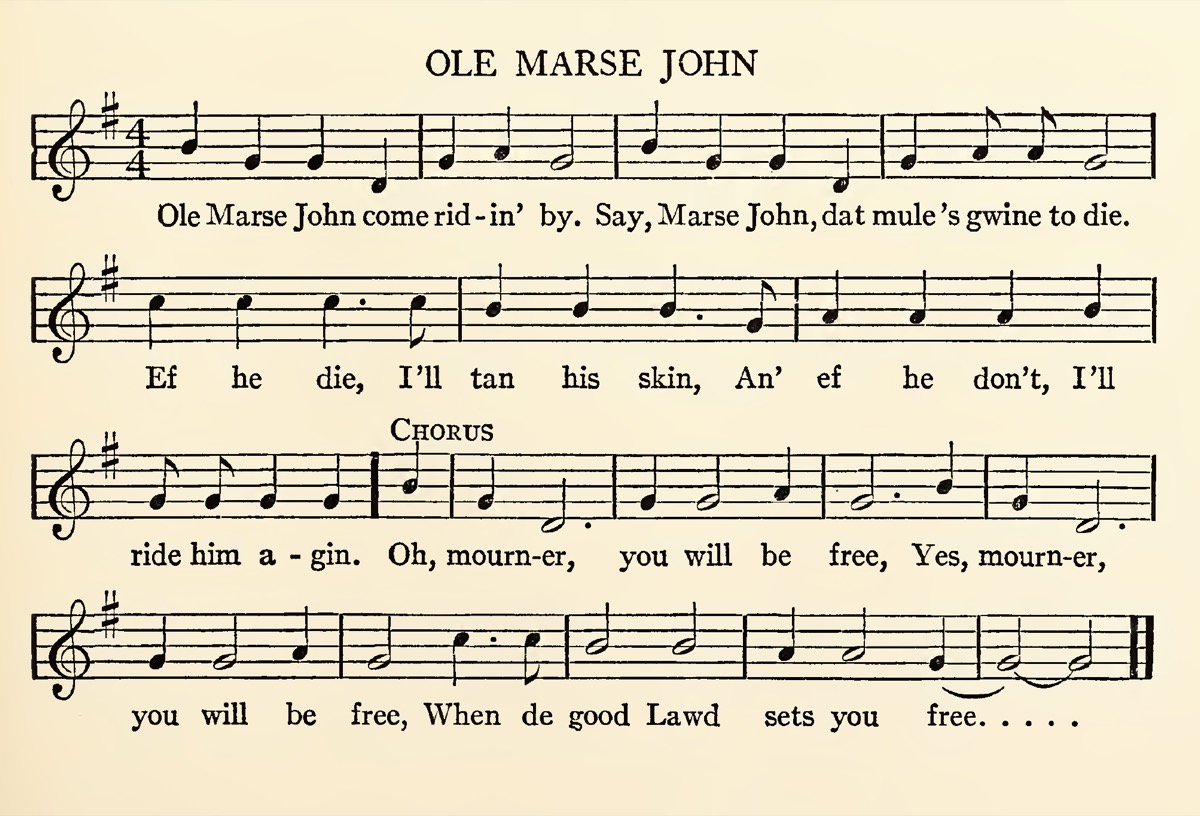
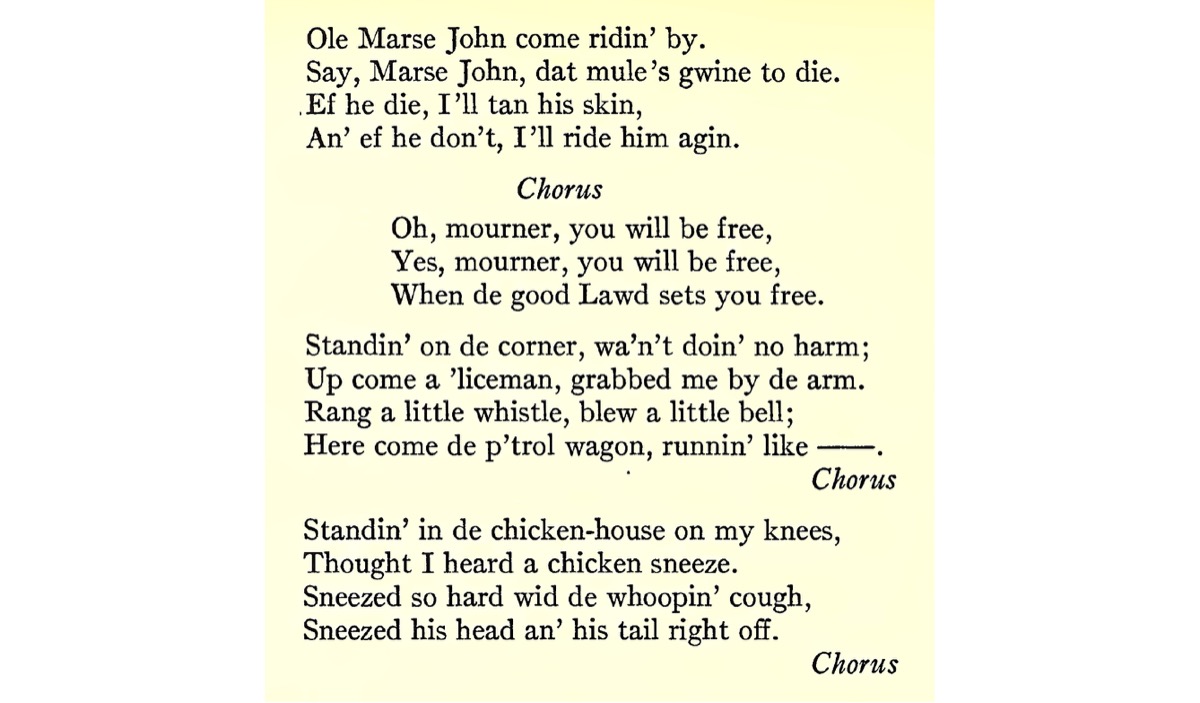
Other versions of the couplet in question provide more coherent storylines, even if they can be vague in some details, such as the one folklorist Gates Thomas collected in 1906 when doing his fieldwork among various African American laborers in Texas. In the lyrics of a song titled “This Mo’nin’, This Evenin, Sometime” appears this stanza:
Standin’ on a corner, didn’t mean any harm, this mo’nin’
Standin’ on a corner, didn’t mean any harm, this evenin’
Standin’ on a corner, didn’t mean any harm
Policeman grabbed me by my arm
This evening!
In this case, the hard-luck narrator (who has just recently lost his lover and his money) does offer some details concerning his interactions with the police, although the exact reason for arrest is never specified. In the last stanza, he says, “Tol’ that policeman to turn me loose,” then adds, “Well, he turned me loose in the calaboose / For sometime.”28 Several possibilities for the police’s actions can be surmised from other moments in song, though. Perhaps the gambling alluded to is the reason for his arrest. Or, as he tells us with braggadocio that “I got my Gatlin in my han’ / This evening,” he could have been taken in on a weapons violation. His lack of money (“I’ll be blamed ef I can see / How all my money got away from me”) might suggest that he was picked up on vagrancy charges.29 Really, any one of these relatively minor offenses could be a possibility in that the police carried out punishment against African Americans in the Jim Crow South of even minor transgressions as a means of asserting racial norms and controlling Black behavior. Day-to-day law-enforcement officers in their own jurisdictions defined legal reality for African Americans in the Jim Crow South, no matter the wording of local and state rules and regulations. We can see this yet again in the lyrics of the Mississippi Sheiks song “Jail Bird Love Song.” It includes a familiar image: “I was walking along the street one day. / I didn’t mean no harm.” But then “The police just looked and they seen me / and they begin to make their law.”30
As noted, southern police often cited minor transgressions of the law to arrest Black citizens, which became a potent tool for repression in the Jim Crow era. In particular, both petty and grand larceny charges, sometimes called “pig laws” when they involved theft of livestock, shifted what had been minor property violations to a higher infractions punished throughout the South by incarceration, often resulting in large fines or jail time with extensive sentences that were then served at hard labor in the various industries clamoring for convict workers.31 In “Feather Bed” by the Gus Cannon Jug Stompers we find these lines: “I went downtown, didn’t mean no harm. / Police grabbed me right by my arm.” In response, the narrator “begin to kick, I begin to rear” as they carry him along with such force and swiftness it “felt like strolling in the air.” Soon Judge Lewis “pulled out a writ,” reads it, and tells the accused, “This means you’ve been stealing. Oh, it’s clear,” even though the narrator reveals in the song that another person has taken the few items of clothing for which he has been charged.32 We find a similar incident involving the supposed theft of minor personal items in Hattie Bolten’s “Jumpin’ Julia,” where the narrator’s “good man” is “arrested for larceny, for stealing two pair of shoes.”33
Howard Odum found several moments where the stated reason for arrest was the theft of livestock, such as where a narrator tells about the adventures of a wayward acquaintance. “On Sat’day night he stole a sheep” but after a quick trial, by “Tuesday he hung like bac’n,” suggesting the dark potential of an execution—just for stealing a farm animal. In other instances, characters offer stories about stolen chickens, which lead to arrest and confinement. In one, an impoverished narrator tells us that “someone stole a chicken in our neighborhood, / They ’rested me on suspicion, it was understood,” and a jury quickly finds him guilty. In the other example Odum offers us, the speaker tells us that “de fust time I seed my brother-in-law, / He had some chickens for sale.” But at their next meeting, “He wuz laid up in Collin’s jail,” for “thirty days,” leaving both the possibility that he did indeed steal the chickens or was automatically assumed to have by the police.34 The Birmingham Jug Band’s “Getting Ready for Trial” also focuses on an episode of chicken thievery, but when the accused “didn’t have a nickel” and “wouldn’t pay no fine,” he ends up as convict labor in a mine.35 Altogether, the arrest by police of African Americans for minor property crimes—and the punishments that come along with these incidents—sets the police more as agents of oppression of Black citizens than protection from property theft.
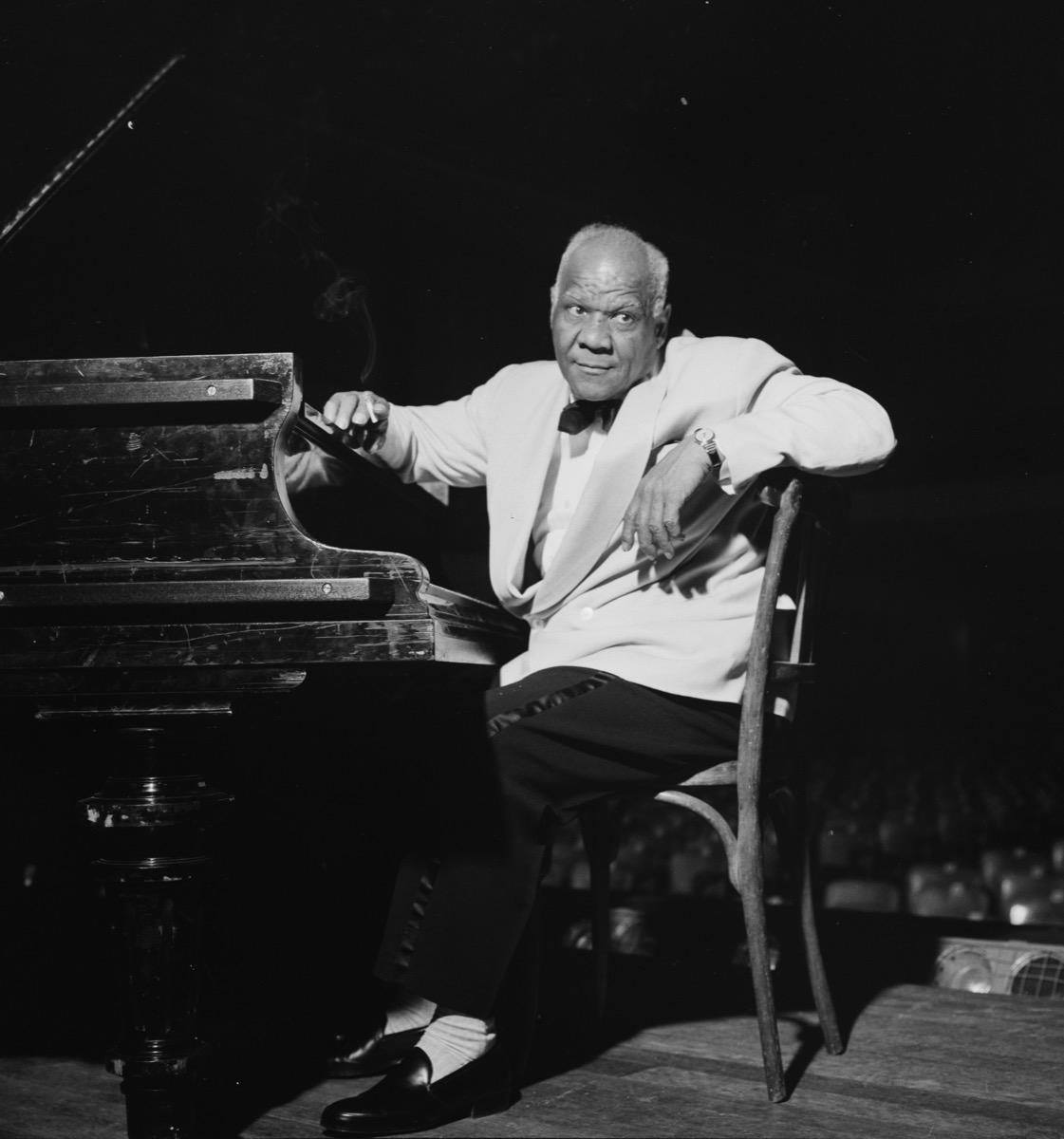
According to historian Howard Rabinowitz, “Blacks were often arrested on grounds of ‘suspicion’” in the Jim Crow era, and he further notes that “a Richmond [African American], charged with being a “suspicious character,” was sent to jail for thirty days.”36 In effect, the mere fact of race could not only set a person for harassment but incarceration. We can even find a specific example of a Black man being picked up by the police for suspicion that eerily matches the lyrics we have been discussing. For around 1912 in Galveston, Texas, jazz legend Sidney Bechet was “standing [on a corner with a friend] . . . waving my hands a whole lot, and two policemen right across the street came over” and “they just grabbed us right there and took us both off to the jail” just because the officers found the Black men questionable.37 But as much truth as these songs and their lyrics hold for any individual, they also point to a much larger and more troubling fact. For the situation of a person identified without evidence as a criminal indicates an unconstitutional authority, as the Fourth Amendment gives citizens the right against unreasonable searches and seizures. This stop-and-frisk image also points out a tear in the very fabric of our laws, a lack of equal protection under the Constitution. For in these songs, only Blacks are subject to this kind of behavior by white police officers, indicating the belief that deep institutional racial bias rather than true legal right authorizes these street-level seizures.
Other seemingly minor offenses bring blues characters into conflict with the police, such as alcohol consumption. In Julia Moody’s “Police Blues,” a wayward lover gets caught up by the authorities: “Just standing on the corner, I didn’t mean no harm. / Along came a policeman and took me by my arm.” He accuses her of being “full of booze,” but throughout her laments about her man leaving, the narrator never directly admits to turning to drink; instead, she tells us that she wandered downtown and simply “stayed too long,” perhaps offering a dual possibility: she did go to a bar and closed it down, resulting in a public drunkenness charge, or any Black citizen lingering on the street late at night might be taken up by the police for no reason. Certainly, she started out the song worried about her failed relationship, but by the last verse, her fears are now fully directed at the police and her incarceration, hence the title.38 Many other blues songs set alcohol consumption as the locus for conflict with law. In “Down in Mississippi” by Johnnie Temple, the Chicago-based bluesman both fears and desires going home to the Jim Crow South: “When I go down in Mississippi, cold tears run down my cheek. / But a many of my friends will I have a chance to meet.” Much of his concern stems from the trouble their drinking could bring, for “if you take a drink of corn whiskey” and the police “smell it on your breath” then “you’re subject to arrest.”39 A similar fear of Mississippi echoes in a completely different song, but one with the same title, by another Chicago-based bluesman, as J. B. Lenoir also reflects on his home state: “I feel just like I’m a lucky man, just to get away with my life.” But why was his survival threated? The law was more likely to protect his persecutors (who “needed no bail”) than him, as “the season was always open on me.”40
Other victimless vice crimes were used to arrest African Americans even though when these same offenses were committed by whites, they were often not observed or punished with the same verve by the law. In particular, a variety of sexual acts could result in conflict with the police. 41 But prostitution appears as the locus for much blues commentary. Perhaps these scenes appear because the underlying reality of the sex industry in this era pointed to the hypocrisy of the Jim Crow system, for southern brothels were segregated affairs concerning customers, even though the sex workers could be African American for white patrons but never white for Black ones. Maybe the white-generated image of Blacks as immoral actors and sexual beasts urged African Americans to push back with narratives of their own. But for whatever reason, many blues songs discussed how sex could get you in trouble with the law, no matter how unjust it might be. In Alice Moore’s “Broadway St. Woman Blues,” we find the lines, “I was standing on the corner just between Broadway and Main. / And a cop walked up, and he asked me my name.” The policeman does eventually arrest the narrator, who admits that she is “a good time woman,” and delivers her to the court for judgment. Other songs also depict similar scenes, but many of them point to the arbitrary and venal nature of the criminal injustice system when the accused “shook it for the judge” and is freed.42
These kinds of comments, seemingly offered in a joking manner in these songs, unfortunately match the reality for some sex workers in the Jim Crow South, as testified to by labor activist Angelo Herndon after spending some time in a New Orleans jail: “Every night the jail took on a festive character. What occasioned such celebration was the fact that the cops brought in hundreds of prostitutes from the red-light district. The poor women were drunk and blatantly noisy. Perhaps it was better so. It helped make things more endurable for them. At first I was amazed at the large number of women that were locked up every night. Finally I discovered that it was just a degraded local racket. The women were arrested in order that filthy tribute might be extracted from them. Upon payment of this ransom their pleas of ‘not guilty’ were accepted.”43 In essence, these blues songs—reflecting a dark reality—set the police as not only enforcers of an unjust system based on race but also real-life exploiters of sex workers for their own personal satisfaction.
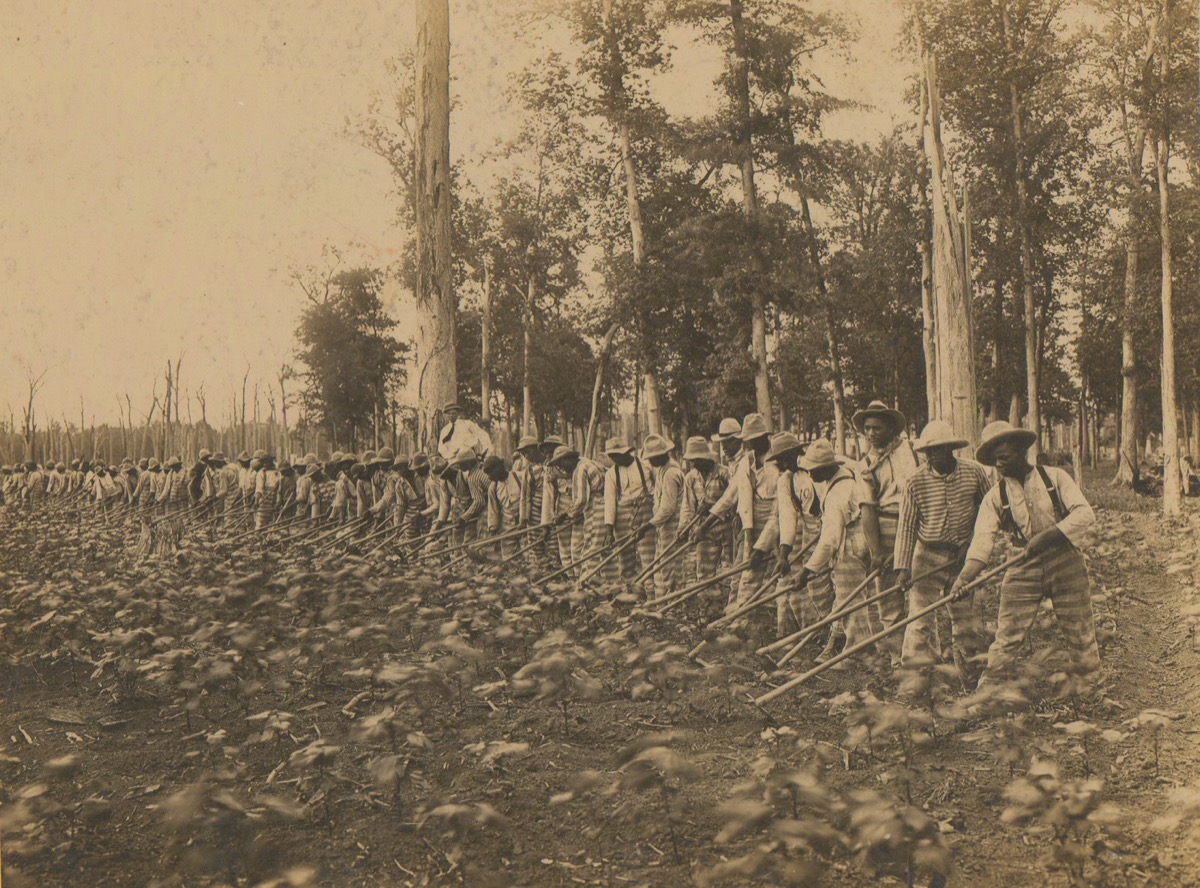
Other songs that contain the couplet we have been discussing also present overt criticism of the police as illicit labor agents. Lawrence Gellert encountered the song “Standin’ on de Corner” while doing fieldwork throughout the Carolinas and Georgia during the 1920s and ’30s. There we find the couplet, “Standin’ on de corner, weren’t doin’ no hahm, / Up come a ’lice-man an’ he grab me by de ahm.” It is followed by lines about patrol wagon called up to take the prisoner, just as in the version noted by Scarborough. But in this narrative, the verse already indicated shifts into another that follows the prisoner to court, where he cries out to the judge, “Ah weren’t to blame.” But this plea is ignored as the judge “wink a ’liceman, liceman wink too,” suggesting that the defendant’s fate has already been settled, not in law as much as by a racialized legal system of injustice. This view is emphasized when the judge tells the narrator, “N[-----,] you get some work to do,” giving him six months on the chain gang. At the end, he laments, “Lawd, white folks won’t let go holdin’ me.”44 This song appears in the folk collection Negro Songs of Protest—its title already suggesting a particular interpretative context. Gellert also added an introduction to this lyric expression of racial injustice when it first appeared in an essay by him in 1934, where he explained how a Black man might be made a prisoner and set to forced labor: “The sheriff takes a walk and jostles a Negro—preferably an out-of-town one (no white friends to butt in). An arrest is made. Disorderly conduct. That’s good for at least 90 days.” We can see similar images in the Mississippi Sheiks’ “Jail Bird Love Song,” as its narrator “was walking along the street one day, I didn’t mean no harm.” But the police “see I was a stranger, they soon got on my trail”45 In particular in his essay, Gellert ties this type of police misconduct to a desire for forced labor, whether it is gotten through disorderly conduct charges, peonage, vagrancy laws, or other means. 46 Certainly, he pushed the notion that this song, containing the couplet we have been discussing, stands as a protest against both the police and the larger legal system they represented as one more desirous of imposed labor than justice.
Another song that draws on this image also reflects the particular argument that Gellert offered. In a chapter entitled “Who Are Subject to Forced Labor” in his 1959 book Jim Crow Guide to the U.S.A., Stetson Kennedy, offers these lines: “Standin’ on the corner, / Waitin’ for my brown; / First thing I knowed / I was jailhouse bound.” Here, the offense appears as vagrancy, as the narrator admits to the arresting officer, “I got no money, / But I got a good excuse.” Unfortunately, “Judge Pickett” ignores this defense, finds him guilty, and intones, “Forty-five dollars / Or take him away!” This sequence of events leaves the prisoner angry, and he directs it at the court: “Wish that mean old / Judge was dead.” Even though the song explicitly points out a villain, it also more implicitly implicates the police and the larger Jim Crow criminal injustice system, which Kennedy indicates, as southern vagrancy laws “say nothing about race,” even as they “are enforced mainly against dark-skinned Americans.”47
We see a similar situation play out in Ramblin’ Thomas’s “No Job Blues,” as the “policeman came along and he arrested me for vag” and then put him to work.48 This storyline falls in line with blues scholar Samuel Charters’s assessment, “In the smaller towns of the South any unfamiliar Negro could be picked up for vagrancy. There was a continual need for labor on the roads and for city maintenance; so local sheriffs have no hesitation in making arrests.”49 In the South, conditions brought about by natural disasters also gave the police motive for imposing sentences so as to gain needed laborers. In Lonnie Johnson’s “Broken Levee Blues,” during a flood on the Mississippi, the police put an innocent man “in jail behind those cold iron bars,” then offer him a choice: “Work, fight, or go to jail.” But at the end, he defiantly vows, “I ain’t building no levee, the planks is on the ground and I ain’t driving no nail.”50 This scenario actually matches the reality discussed by Jonathan Daniels in A Southerner Discovers the South, wherein a local police chief related how during the 1937 Mississippi flood, Boss Crump of Memphis had ordered his officers to either hire Black workers or arrest them for vagrancy so as to have the necessary labor to reinforce the levees that protected the town.51
Certainly, many moments in blues songs offer the threat and reality of arrest for various crimes, along with the possibility of suffering forced labor as a result, but beyond these kinds of situations also come the prospect of police violence. Julius Daniel offers up this scene: “Standing on the corner, talking with my brown. / Up stepped a policeman, hit both of us down.”52 No warning is offered, and no prompting crime is indicated. But the image of unprovoked police brutality stands out—although it does not stand alone. Other blues songs also depicted officers as agents of baseless aggression and assault. In Blind Blake’s “Third Degree Blues,” we find the narrator “on my way home” one morning, when “a policeman walked up and caught me by my arm.” The officer takes him prisoner, but rather than being tried, he is held without bond for days. Then the police “beat me and kicked me, and put me through the third degree.” Afterward, they “put me in the cellar without my clothes and shoes,” leaving him screaming, “I’ve got the third degree blues.”53 This disturbing sequence of harassment, arrest, and torture presents the police not just as an adversarial force but as tormentors, even as the song never even hints at the purpose the third degree was meant to serve. Did they want him to confess to some crime? Did they want him to implicate others in illicit activity? Perhaps the persecution was the point—the police were showing their power over Blackness, leaving no doubt as to where authority lay.
In a different song with the same title, Eddie Boyd also laments how the police abuse their power, as they accuse his narrator of a variety of crimes, even though he refutes each one. In response, he moans, “Bad luck, bad luck is killing me.” But as he externalizes the power over him, as he never terms the “luck” as his, might he mean that his situation stems not from any action he has taken but from the bad luck of being born Black in a racist nation? More certainly, he tells us, “Well, I just can’t stand no more of this third degree,” as he reaches his breaking point from his torments.
But none of these scenarios suggest this kind of police response is necessary, which matches what some scholars have argued. Guy B. Johnson, in his esteemed essay “The Negro and Crime,” claims that the white police can “use brute force against Negroes with impunity,” which “must give rise to considerable bitterness and a feeling that the law is unjust.”54 But this situation does not just exist in the abstract, for we can find many particular testimonials supporting the claim of police abuse, even against innocent Blacks. In remembering his past in the Jim Crow town of New Orleans, Louis Armstrong references police violence again and again, setting it as a natural state for any Black man caught up by white authority: “Even if we colored ones were right, when the cops arrived they’d whip our heads first and ask questions later.”55 These individual acts of police violence add up, exposing a larger system of abuse and violence. In fact, the Civil Rights Congress used evidence of various assaults and murders of Black citizens by white officers from 1945 to 1951 to claim, “the killing of Negroes has become police policy” in their appeal to the United Nations entitled “We Charge Genocide: The Crime of Government Against the Negro People in 1951.” Although this indictment covered the whole of the nation, the document explicitly argued that “the primary locale of the genocide being practiced against the American Negro people, both historically and geographically, is the so-called Black Belt of the southern United States,” with the police as the primary agents of this carnage.56
As a result of this history of abuse by authorities, moments of anger against the larger system of criminal injustice appear in songs that draw on this particular image of the police. For example, in June of 1939, folklorist Herbert Halpert traveled to Parchman Farm, the state prison of Mississippi, as part of a months-long effort to collect folk songs throughout the South for the Works Progress Administration’s Joint Committee on Folk Arts. Among other pieces, he recorded “No Mo’ Freedom” as sung by Eva White. In it appear the lines, “I was standing, standing on the corner of North Farish and Church Street, / When that old big bad policeman came up and arrested me.” No illegal actions are noted or charges even mentioned, leaving a listener to suppose an unjust arrest of a Black citizen. But the jurors—who would have been all white—hearing the case quickly find the narrator guilty, landing her in Parchman. The song adds in its title phrase, leaving the prisoner “sick as I can be.” But in the end, she promises, “Someday I will go free. / I’m going to treat all you people just like you treated me.”57 White’s angry turnabout embodies a threat against those who put her in prison, becoming a call for the enforcers of the Jim Crow criminal injustice system to be on the receiving end, for once, of the punishments regularly doled out to Black defendants.58 Certainly, the reality that the entire legal structure was prejudiced always imbues this image of the police, but some of the songs containing it also include the desire to retaliate.
7Striking Back
Blues songs did not merely note racialized policing and its resulting anger without also offering up images of violence against the police. In “It’s Lookin’ for Railroad Bill,” the song noted earlier that was collected by Howard Odum and containing the key couplet, the narrator, rather than Railroad Bill, ends up being taken up by the police in a case of mistaken identity as they were in search of the titular character, an African American desperado who was active in Alabama and Florida in the 1890s. But in that “Railroad Bill mighty bad man,” “the worst ole coon,” and other similar negative sentiments appear throughout the piece, the narrator can be seen in agreement with efforts to apprehend this outlaw rather than being completely outraged by his own encounter with the police.59 Yet Railroad Bill often appears in song and story as an African American folk hero, one who actually killed several police officers during his years-long crime spree.60 Also, as part of an appreciation for Black outlaws, negative designations may well be seen as positive, as H. C. Brearley noted in a 1939 essay entitled “Ba-ad N[-----]”: “[In] many Negro communities . . . this emphasis upon heroic deviltry is so marked that the very word bad often loses its original significance and may be used as an epithet of honor.”61 Since then, many other scholars have made similar assessments of how “bad man” characters in Black folklore and folksong are actually often portrayed as protective or even heroic figures, even as seemingly negative language is used to describe them.62 Additionally, the police appear here in force: “Comin’ down sidewalk two by two.” Finally, we are faced with an image that can easily be seen as yet another incident of harassment by the police of African Americans, one that suggests more than inconvenience. For in reality, several innocent African American men, described as “suspicious” by newspaper reports of the era, were arrested, abused, and even killed by various white officers of the law in Alabama, Florida, Georgia, Mississippi, and Texas during the hunt for the real-life Railroad Bill.63 But this outlaw fought back against this kind of harassment and violence, just as other Black “bad man” figures do in other blues songs, making them representative avengers.
Little Harvey Hull and Long “Cleeve” Reed’s “Original Stack O’ Lee Blues” takes up the story of a legendary African American bad man hero and includes these lines: “Standin’ on the corner, well, I didn’t mean no harm. / Well, a policeman caught me, well, he grabbed me by my arm.”64 But this song does not follow most versions, which usually set Stack as murdering Billy Lyons over a hat during a gambling session. As Cecil Brown notes, this iteration of the song “changes the traditional version” by “making Billy Lyons a policeman and Stagolee his potential victim.”65 In the beginning of the song, Stack “bullied two, three coppers down” with a knife and taunted Lyons, “You arrest a man just as bad as me, but you won’t arrest me?” But then the story turns without explanation, leaving Stack pleading for his life for the sake of his two children and wife. Perhaps the audience needs no justification for Stack’s supplication, as they would understand that any actions taken against the police by an African American would come with the threat or even the reality of violence. Here, in reply to his entreaty, Lyons snarls, “Well, you may see your children again, but it’ll be in another world,” suggesting that he will kill Stack, his children, or all of them.66 When a fight breaks out as a result of these confrontations, Stack slays the policeman and escapes into the night, suffering no punishment for murdering the officer and leaving this bad man folk hero free to act against the police again. In a moment in time where the police harass, arrest, assault, and even kill African Americans daily, Stack reverses this reality, with him as an agent of calamity rather than its victim. These two blues ballads work to turn victimizer into victim, reversing an all-too-often reality wherein African Americans suffered at the hands of the police.
8Conclusion
In response to the unjust treatment of Blacks by police, Black characters defend themselves against the police, and sometime initiate aggression, perhaps as a symbolic act against larger forces at play in the Jim Crow South. Certainly, blues performers created cop-killer characters and images in their work as part of a larger collective condemnation of police prejudices, abuses, and violence directed at Black America as represented by the many songs presented here. But in reality, the police rather than these Black folk heroes had the power—they had the guns, the numbers, and the courts to back any action they would take against the Black community. Sterling Brown channels this stark reality in his 1939 poem “Old Lem,” which details how the police play a primary role in how daily racial repression is maintained: “They got the sheriffs / They got the deputies / They don’t come by twos,” but “they come by tens.”67 Here, the poet evokes a fearful image of an army of police, all of whom will fall with great violence on any African American who would resist the Jim Crow order, echoing blues singer Alice Moore’s lyric, “Oh, my babe, the law outnumbers you a thousand to one.”68 Railroad Bill and Stack O’ Lee take on white authority in some versions of their for a variety of reasons, but according to scholar Jerry Bryant, they still “are bound inescapably by white law, and are figures of awe and pity,” which suggests that even as these songs offer the same potential for a violent action against racist policing, these figures’ actions are inevitably futile resistance to the repressive system of policing that the Black community endured.69 For any individual Black person who ran afoul of this force was bound to lose, to be destroyed by the larger racist system that they represented, no matter the motive—or the righteousness—behind these characters’ actions against the repressive police.
As a whole, the songs of the corner take on two main roles. These cultural creations offer the Black community’s tales of police harassment and abuse, but some also contain imagining of revenge against this white authority. The former document the truths of the era—that the police could grab you up for any reason, real or imagined. They could arrest, abuse, or torture you. But the songs about of Railroad Bill and Stack O’ Lee stand as creative expressions of anger against law enforcement and the white-controlled power complex they represent. Thus, these songs work together to both reflect the image of danger and criminality imposed on the Black community but to also resist the idea that they will be passive, accepting of their marginal status under the white-established law and its enforcers. As Paul Garon notes when speculating on the nature of aggression in the blues: “To interpret the blues solely as a sociological statement on black life in America is to fail to account for the numerous contradictions that are understandable only in terms of psychic activity. The most vital sense in which the blues singers act as ‘reporters’ is the way they become reporters of the mental processes. Not so much the social or economic conditions of black life in America, but the effects of these conditions on the mind are expressed in the blues. Thus what the songs contain may be ‘reflections’ of reality, but they might also contain images projected with the purpose of overcoming reality.”70
So, we might see these songs not purely as violent rebellion or hopeless acts but instead as a willed creative resistance to the larger forces at play in the era of their expression, establishing reflections of the actual belief of the Black community that police violence must be resisted. As H. Bruce Franklin notes, “It was possible to project onto the legendary Black Bad Man all the desire for rebellion against the white man’s law and order.”71 Thus, they allow for creative re-imaginings, setting the possibility that unjust or cruel deeds might be met with an equal resisting force. For before you can act, you must imagine a future where present wrongs are overcome, one where even a powerful aggregation pushing against you could be struck down, could be defeated. These blues creators may not have had the power to overcome the injustice that existed in the era of Jim Crow, but they still had the talent to imaginatively protest the very system that they took on in their fictive depictions, where a lone figure decides to kill a cop.
Perhaps the drive to castigate the police, even imagine killing them, in blues song results from their supposed edict, which is to represent order and law as a means of manifesting equal justice for all. Ideally, the state (especially through the police) provides protection for all people and their property, thereby instilling an agreement wherein these citizens reciprocate by obeying duly imposed law, even those that limit or govern their actions. In essence, the police are to be the day-to-day, street-level agents of order and regulation—but also of fairness and justice. When they abuse their positions, betray their duties, they undercut the very faith of the people in the greater institutions that they represent, eroding or even voiding the social contract that citizens have with the law. We can see this linking of inequality with policing when, in reflecting on her childhood in Durham, North Carolina, civil rights activist Pauli Murray remembers the day-to-day markers of Jim Crow: “The signs which literally screamed at me from every side—on streetcars, over drinking fountains, on doorways: FOR WHITE ONLY, FOR COLORED ONLY, WHITE LADIES, COLORED WOMEN, WHITE, COLORED.” But if she happened to forget or ignore these messages, a fearful presence was on hand to emphasize the systemic inequality they represented: “a heavily armed, invariably mountainous red-faced policeman who seemed more to me a signal of calamity than of protection.”72 Here, Murray directly ties the restrictions of Jim Crow to its primary enforcer, the police. Thus, in supporting a racialized system, officers remove all hope that the Black community will have belief in any component of the larger legal structure. Certainly, there was a desire for community policing—but just of the color-neutral variety, such as appears in one of the recorded sermons of the famed Reverend J. M. Gates, who argues for equal justice from the police: “You ought to be a protection of men and women of the city. Not the black man or the white man or the copper-colored man, or the brown man, but you ought to be a protection of the city wherein you are hired.”73 But when the police failed in this duty to protect African Americans equal to their white counterparts as they went about their daily business, when they were seen to be agents of racism instead, the blues made sure to bear lyric witness.
In fact, all the blues discussed here—and many others not noted—represent a part of the oppositional culture, a socially conscious folk/popular expression of communal dissatisfaction with the failure of the police to be enforcers of race-neutral laws and servants of justice. Blues song denounces these Jim Crow injustices, calls them out by name. They document set scenes of police abuse and brutality and shout out against the second-class citizenship of working-class Blacks in the South. In effect, they become a communication network, one sending out individual messages that coalesce into a detailed collective denunciation of the Jim Crow legal system, one lacking true justice for all, and indirectly calling for systemic change. As Sherley Williams argues, “Blues is action, rather than contemplation, for the song itself is the creation of reflection. And while not all blues actions achieve the desired result, the impulse to action is inherent in any blues which functions out of a collective purpose.”74 Although the blues does not always register as a musical form that has been as integral to social change as some others, such as freedom songs and rap, it nonetheless encodes itself with the wrongs that the Black community suffers and implicitly demands a change for the better, not just concerning the white police force but the entire legal system undergirding it. It is part of the spark that would become the flame of the civil rights movement of the past, a fire that still needs much tending in our own era.
Notes
- For further discussion of sexual violence against Black women and children by white men in the South, see Crystal Feimster’s Southern Horrors: Women and the Politics of Rape and Lynching. Harvard University Press, 2009; and Danielle McGuire’s At the Dark End of the Street: Black Women, Rape, and Resistance. Alfred Knoff, 2011.
- See Remembering Jim Crow: African Americans Tell about Life in the Segregated South. The New Press, 2001: 9-11,27-29, 50, 218-219, 232-233, 235, 274-276, 308, and 312.
- For detailed discussions of the reality of white policing of African Americans in the South, see Jeffrey Adler’s Bluecoated Terror: Jim Crow New Orleans and the Roots of Modern Police Brutality. Oakland: University of Californian Press, 2024; and Brandon Jett’s Race, Crime, and Policing in the Jim Crow South. Baton Rouge: Louisiana State Press, 2021.
- Sterling Brown. “The Blues.” Phylon. 13:4, 1952: 288-290.
- See William Francis Allen, Lucy McKim Garrison, and Charles Pickard Ware’s Slave Songs of the United States. New York: A. Simpson & Co., 1867: 89; and Dorothy Scarborough’s On the Trail of Negro Folk-Songs. Cambridge: Harvard University Press, 1925: 24.
- Quoted in Sally Hadden’s Slave Patrols: Law and Violence in Virginia and the Carolinas. Cambridge: Harvard University Press, 2001: 71.
- W. E. B. Du Bois. The Souls of Black Folk. New York: Penguin Books, 1996: 144 and 145.
- Hadden 4, 69,84,103, 168,198,202, and 212.
- W. Marvin Dulaney. Black Police in America. Bloomington: Indiana University Press, 1996: 13-17.
- Leon F. Litwack Trouble in Mind: Black Southerners in the Age of Jim Crow. New York: Vintage Books, 1999: 277.
- Colin Dayan, The Law Is a White Dog: How Legal Rituals Make and Unmake Persons (Princeton University Press, 2011), xii.
- Dayan, The Law Is a White Dog, xiv.
- Bryan Wagner, Disturbing the Peace: Black Culture and the Police Power After Slavery (Harvard University Press, 2009), 3, 5.
- Wagner, Disturbing the Peace, 6–7.
- Wagner, Disturbing the Peace, 16–17.
- Khalil Gibran Huhammad. The Condemnation of Blackness: Race, Crime, and the Making of Modern Urban America. Cambridge: Harvard University Press, 2010: 4.
- Fred Moten and Stefano Harney. “Blackness and Governance.” Beyond Biopolitics: Essays on the Governance of Life and Death. Ed. Craig Willse and Patricia Ticineto Clough. Duke University Press, 2011, pp. 352-54.
- Edward Ayers. Vengeance and Justice: Crime and Punishment in the 19th Century American South. New York: Oxford University Press, 1984: 174
- H. Bruce Franklin also notes the wide use of these lines in “Songs of an Imprisoned People.” MELUS. 6:1 (Spring) 1979: 9-10.
- Risa Goluboff. Vagrant Nation: Police Power, Constitutional Change, and the Making of the 1960s. Oxford University Press, 2016: 5.
- George Evans. “Standing on the Corner, Didn’t Mean No Harm!” New York: Howley, Haviland, and Company, 1893.
- William H. Tallmadge. “Ben Harney: The Middlesborough Years, 1890-93.” American Music. Summer 1995: 170-172, 180-183.
- Ben Harney and John Biller. “You’ve Been a Good Old Wagon But You’ve Done Broke Down.” Louisville: Greenup Music Company, 1895. Bessie Smith’s 1925 song shares a title with Harney’s composition, but the music and the lyrics are completely different.
- The couplet discussed in this section may have also been transmitted further by other sources, such as a children’s song about unwanted bugs or even a jump rope rhyme. For the latter, see Roger Abrahams’ Jump Rope Rhymes: A Dictionary. Austin: University of Texas Press, 1969: 92.
- Howard W. Odum. “Folk-song and Folk-Poetry as Found in the Secular Songs of the Southern Negroes.” Journal of American Folklore. 24:93 (July-Sept.) 1911: 291.
- Dorothy Scarborough. On the Trail of Negro Folk-Songs. Cambridge: Harvard University, 1925: 163-164.
- For some examples, see John and Alan Lomax’s American Ballads and Folk Songs. New York: Macmillan Company, 1934: 254-258; and Mary Gordon. Quoted in William Ferris’ Give My Poor Heart Ease: Voices of the Mississippi Blues. Chapel Hill: The University of North Carolina Press, 2009.22-23
- Gates Thomas, “South Texas Negro Work-Songs: Collected and Uncollected,” Rainbow in the Morning, ed. J. Frank Dobie (Texas Folklore Society, 1926; repr., Southern Methodist University Press 1975), EPUB.
- Thomas, Rainbow in the Morning.
- Mississippi Sheiks. “Jail Bird Love Song.” New York: Okeh 8834: Side A.
- For a useful discussion of how and why these laws were enacted beginning in the late 19th century in the South, see See William Cohen’s “Negro Involuntary Servitude in the South, 1865-1940: A Preliminary Analysis.” The Journal of Southern History. 42:1 (February) 1976: 42-59; and Pippa Holloway’s “‘A Chicken-Stealer Shall Lose His Vote’: Disenfranchisement for Larceny in the South, 1874-1890.” The Journal of Southern History. 75:4 (November) 2009: 931-962.
- Gus Cannon’s Jug Stompers. “Feather Bed.” New York: Victor 38515, 1928: Side B.
- Hattie Bolton. “Jumpin’ Julia.” Recorded in Chicago in May 1938 for Vocalion but not released until it found its way onto Blue Ladies, Vol 2, 1937-1939. Document Records, 1989: Side One, Track Three.
- Howard W. Odum. “Folk-Song and Folk-Poetry as Found in the Secular Songs of the Southern Negroes.” Journal of American Folklore. 24:94 (October-December) 1911: 372, 374, and 388.
- Birmingham Jug Band. “Getting Ready for Trial.” Okeh 8856, 1930: Side B.
- Howard N. Rabinowitz, “The Conflict Between Blacks and the Police in the Urban South, 1896–1900,” Historian 39:1 (November 1976): 68.
- Sidney Bechet. Treat It Gentle: An Autobiography. New York: Hill and Wang, 1960: 105.
- Julia Moody. “Police Blues.” Columbia Records 14103-D, 1925: Side A.
- Johnnie Temple. “Down in Mississippi.” Decca Records 7643: Side B.
- J. B. Lenoir’s “Down in Mississippi” was first recorded in Chicago on May 5, 1965, but it was not released until 1969 on Look Out, Sam! Scout Records: Side 1, Track 3.
- Douglas Blackmon. Slavery by Another Name: The Re-Enslavement of Black Americans from the Civil War to World War II. New York: Anchor Books, 2009: 7, 53, 79, 81, 99, 108, 112, 281, 303, 313, 375, and Franklin 8.
- For examples, see Lonnie Johnson’s “She’s Dangerous with That Thing,” Tampa Red’s “No Matter How She Done It,” and Merline Johnson’s “Love with a Feeling.”
- Angelo Herndon. Let Me Live. New York: Random House, 1937: 117.
- Lawrence Gellert. Negro Songs of Protest. New York: American Music League, 1936: 21.
- Mississippi Sheiks. “Jail Bird Love Song.” Okeh 8834, 1930, Side A.
- Lawrence Gellert. “Negro Songs of Protest: North and South Carolina and Georgia.” Negro: Anthology. ed. Nancy Cunard. London: Wishart and Company, 1934: 369, 374.
- Stetson Kennedy. Jim Crow Guide to the U.S.A.: The Laws, Customs and Etiquette Governing the Conduct of Nonwhites and Other Minorities as Second-Class Citizens. London: Lawrence & Wishart, 1959: 131-132. For a further discussion of how vagrancy laws were used against African Americans, see Goluboff.
- Ramblin’ Thomas. “No Job Blues.” 1928 Paramount 12609, 1928: Side A.
- Samuel Charters. The Poetry of the Blues. Oak, 1963: 103.
- Lonnie Johnson. “Broken Levee Blues.” Okeh 8618, 1928: Side A.
- Jonathan Daniels. A Southerner Discovers the South. New York: The Macmillan Company, 1938: 60-61.
- Julius Daniel. “My Mamma Was a Sailor.” Victor 20658, 1927: Side A.
- Blind Blake. “Third Degree Blues.” Paramount 12867, 1929: Side B.
- Guy B. Johnson. “The Negro and Crime.” Annals of the American Academy of Political and Social Sciences. 217 (September) 1941: 97.
- Louis Armstrong, Satchmo: My Life in New Orleans. New York: Signet, 1955, 60, 73, 75, 98, 116, 135, and 137.
- William L. Patterson et. al. We Charge Genocide: The Historic Petition to the United Nations for Relief from a Crime of the United States Government Against the Negro People. New York: International Publishers, 1970: 9, 10-12, 22, 58-121. For a futher discussion of police murder of African Americans, see Margaret Burham’s By Hands Now Known: Jim Crow’s Legal Executioners. New York: W.W. Norton and Company, 2022.
- Eva White. “No Mo Freedom.” Jailhouse Blues. New York: Rosetta Records, Side B, Track 1.
- Sarah Haley offers up a interesting reading of this song in No Mercy Here: Gender, Punishment, and the Making of Jim Crow Modernity. Durham: University of North Carolina Press, 2016: 222-223.
- Odum, “Folk-song and Folk-Poetry as Found in the Secular Songs of the Southern Negroes,” Journal of American Folklore 24, no. 93 (July-September 1911): 291.
- See “‘Railroad Bill’ and the American Outlaw Tradition.” Western Folklore. 40:4 (October) 1981: 315-328.
- H. C. Brearley. “Ba-ad Nigger.” South Atlantic Quarterly. 38:1 (January) 1939: 75.
- For examples, see Lawrence Levine’s Black Culture and Consciousness: Afro-American Folk Thought From Slavery to Freedom. Oxford: Oxford University Press, 1977: 407-420; and Cecil Brown’s Stagolee Shot Billy. Cambridge: Harvard University Press, 2003: 148-157.
- Burgin Mathews. “‘Looking for Railroad Bill:’ On the Trail of an Alabama Badman.” Southern Cultures. 9:3 (Fall) 2003: 76-77, 79.
- Little Harvey Hull and Long “Cleeve” Reed (Down Home Boys). “Original Stack O’ Lee Blues.” Black Patti, 8030, 1927: Side B.
- Brown 152.
- Hull and Reed, “Original Stack O’ Lee Blues.”
- Sterling Brown. “Old Lem.” The Collected Poems of Sterling Brown. Ed. By Michael S. Harper. New York: Harper & Row,1980P 180-81.
- Alice Moore. “Cold Iron Walls.” Paramount 12973, 1930: Side B.
- Bryant 13.
- Paul Garon, The Blues and the Poetic Spirit, City Lights, 1996: 65.
- H. Bruce Franklin 13.
- Pauli Murray. Proud Shoes: The Story of an American Family, Harper & Brothers, 1956: 268.
- J. M. Gates. “Men and Women Talk Too Much.” Bluebird B8382, 1940.
- Sherley A. Williams. “The Blues Roots of Contemporary Afro-American Poetry.” Write Me a Few of Your LInes: A Blues Reader. ed. by Steven Tracy. Amherst: University of Massachusetts Press, 1999: 446.